
Why Legacy Industrial Sourcing Software Fails Modern Supply Chains
Legacy industrial sourcing software is failing modern enterprises, driving up integration costs and blocking AI adoption. Learn why custom solutions are the key to building resilient supply chains.
Published on September 30, 2026 · Updated on September 30, 2026
Legacy industrial sourcing software refers to outdated, rigid procurement systems that fail modern supply chains because they cannot integrate disparate data or scale with AI. Today, 95 percent of organizations struggle with system integration, and only 2 percent have integrated more than half of their applications, leaving supply chains vulnerable to severe disruptions [2].
These legacy platforms isolate critical data, creating massive silos that block digital transformation and slow down decision-making. As global supply chain shocks lasting longer than a month now occur every 3.7 years on average, companies relying on inflexible software face catastrophic profit losses of up to 45 percent of a year's profit over a decade [8]. Modern businesses require highly integrated, custom solutions to survive.
To help organizations navigate these challenges, About AppBrewers designs custom, AI-accelerated enterprise platforms that unify fragmented workflows and eliminate technical debt. By moving away from rigid, off-the-shelf packages, companies can build resilient sourcing networks that adapt to real-time disruptions.
Why Legacy Systems Fail to Prevent Supply Chain Disruptions
The modern procurement landscape is defined by continuous volatility, yet legacy industrial sourcing software remains frozen in a deterministic, pre-digital era. Because these systems lack the flexibility to adapt to real-time market shifts, companies remain highly exposed to frequent and costly global supply chain shocks [8]. Disruptions lasting longer than a month now occur every 3.7 years on average, costing businesses up to 45 percent of a single year's profit over a decade [8].
This vulnerability is compounded by a profound lack of transparency. More than 40 percent of organizations have limited or no visibility into Tier 1 supplier performance [6]. Despite years of documented supply chain volatility, legacy systems lack the digital maturity required to track basic supplier metrics, leaving procurement teams in a permanent state of reaction. Compounding this issue, cost pressures and competing large-scale IT projects, such as legacy ERP replacements, have forced organizations to scale back critical digitization efforts. In fact, the share of companies planning major investments in digital supply chain systems plummeted from 47 percent to 25 percent in a single year [8].
The Staggering Financial Toll of Technical Debt
Maintaining outdated industrial sourcing software does not just limit visibility; it actively drains corporate capital. Approximately $370 million is lost annually across enterprises due to inefficiencies in modernizing legacy systems [10]. Outdated methodologies and accumulated technical debt in legacy transformation projects lead to massive financial waste, which includes $56 million spent solely on maintenance and integration with legacy technology [10].
These inefficiencies frequently culminate in total project failure. By 2027, more than 70 percent of recently implemented ERP initiatives will fail to fully meet their original business case goals, with as many as 25 percent failing catastrophically [3]. Industry research traces these failures to a consistent set of issues: a lack of executive commitment, a lack of understanding of the organizational change required, and weak data governance [3]. Businesses looking to escape this cycle can get a quote for a custom application designed to replace bloated legacy codebases with modern, agile workflows.
The Integration Bottleneck: Why Off-the-Shelf Packages Stagnate
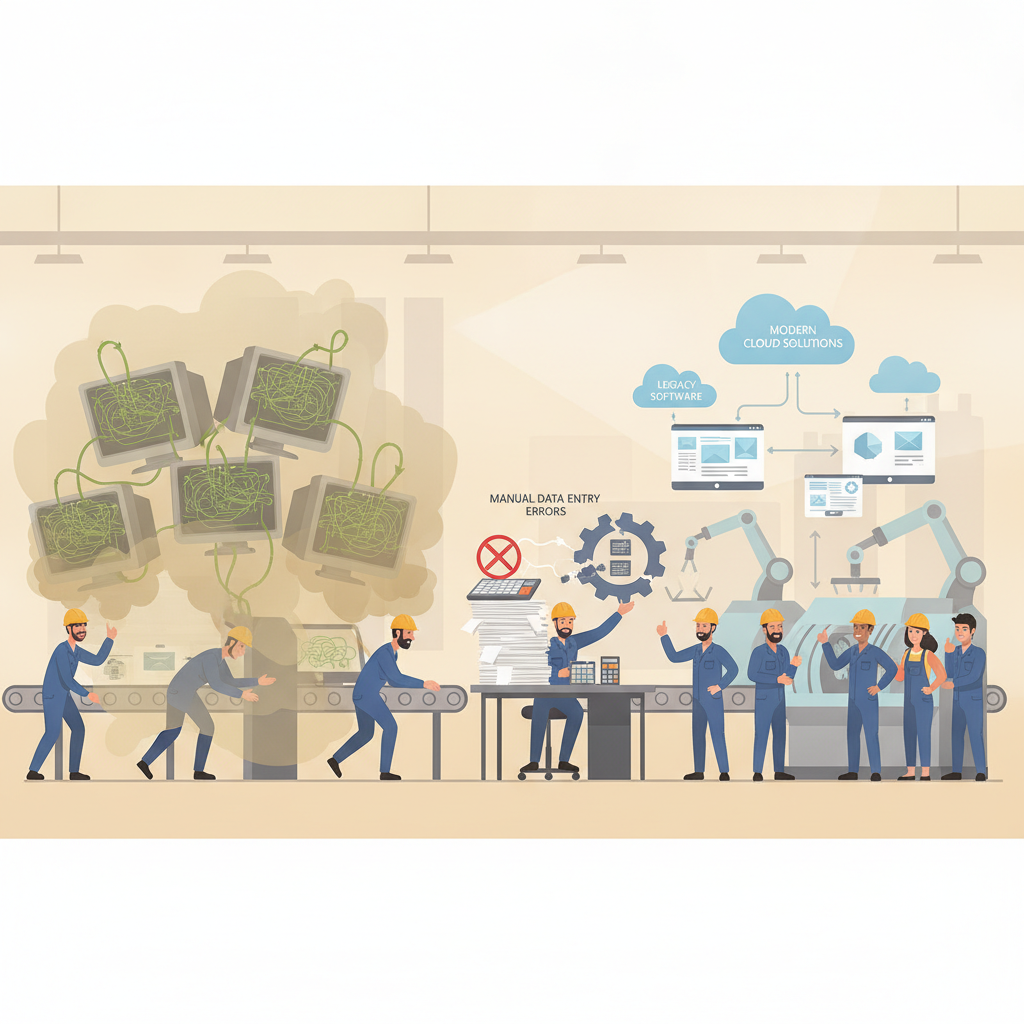
The core flaw of off-the-shelf industrial sourcing software is its inability to connect with the rest of the enterprise ecosystem. Legacy infrastructure blocks digital transformation, creating massive data silos that isolate procurement from inventory, logistics, and manufacturing operations [2].
When off-the-shelf software fails to match the unique workflows of a specific factory, teams are forced to rely on highly inefficient manual workarounds. This manual overhead introduces significant operational risk. In contrast, custom software solutions can reduce manual data entry by 65 percent and inventory errors by 78 percent compared to rigid, pre-packaged software [7]. By tailoring the software to the actual operations of the business, organizations eliminate the friction that defines legacy systems.
Why Legacy Procurement Blocks Agentic AI and Digital Adoption
As enterprises rush to deploy artificial intelligence, they are finding that legacy industrial sourcing software acts as a major roadblock. Organizations with integrated data systems achieve 3 times faster AI implementation timelines compared to those managing disparate, fragmented platforms [8]. Data fragmentation across legacy systems is the primary obstacle slowing down the progress of generative AI in procurement [8].
Furthermore, traditional procurement frameworks designed for stable, deterministic software are actively blocking agentic AI from scaling, keeping most deployments trapped at the proof-of-concept stage [4]. Legacy procurement templates and governance workflows cannot accommodate continuously evolving, autonomous AI systems that distribute accountability across multiple vendor layers [4].

Even when organizations attempt to modernize, they often fail to prepare their workforce. By 2028, 60 percent of supply chain digital adoption efforts will fail to deliver promised value due to insufficient investment in learning and development [3]. Chief supply chain officers often jeopardize technology initiatives by failing to equip teams with the skills needed to leverage new tools [3]. Consequently, only 7 percent of organizations possess mature procurement systems capable of modeling future disruption scenarios, while 75 percent of procurement functions fail to implement advanced risk programs due to gaps in data and analytics [4].
How to Modernize Your Sourcing Software Infrastructure
To overcome the limitations of legacy industrial sourcing software, organizations must adopt a systematic approach to modernization:
- Audit your integration landscape: Map out legacy data silos and identify where the 95 percent integration struggle is most severely affecting your operations [2].
- Prioritize data unification over ERP replacement: Build integrated data layers first to accelerate AI implementation timelines by up to 3 times [8].
- Design custom workflows for factory floors: Avoid generic off-the-shelf packages and develop tailored tools that reduce manual data entry by 65 percent [7].
- Invest heavily in team learning and development: Prevent the common 60 percent digital adoption failure rate by training employees on new digital supply chain tools [3].
- Establish risk-modeling capabilities: Upgrade procurement frameworks to actively model future disruption scenarios, moving beyond the reactive state that plagues 75 percent of procurement functions [4].
Custom Sourcing Software vs. Legacy Off-the-Shelf ERPs
The choice between generic legacy software and custom-built solutions has a direct impact on operational efficiency and risk resilience.
| Feature | Legacy ERP / Off-the-Shelf Software | Custom Sourcing Software (AppBrewers) |
|---|---|---|
| Integration Capability | Only 2% of organizations integrate more than half of their apps [2] | High API connectivity, seamless data unification |
| AI Implementation Speed | Slowed down by fragmented data across legacy systems [8] | 3x faster AI implementation timelines [8] |
| Manual Workloads | High; generic software forces manual workarounds [7] | 65% reduction in manual data entry [7] |
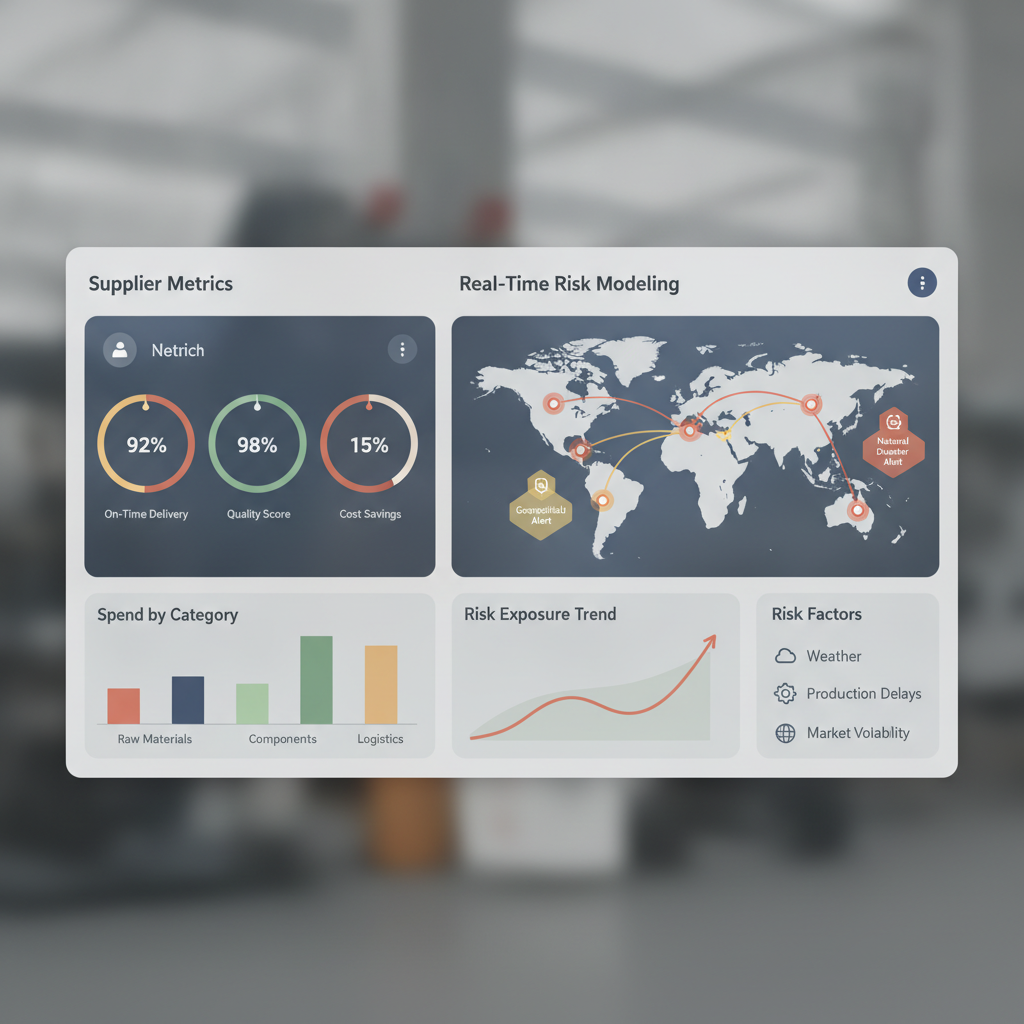
| Risk Modeling | Lacks advanced risk programs; reactive [4] | Dynamic predictive modeling for global disruptions [4] |
Frequently Asked Questions
Why do most modern ERP initiatives fail to deliver results?
By 2027, over 70 percent of recently implemented ERP initiatives will fail to meet their business case goals, with 25 percent failing catastrophically [3]. These failures are primarily driven by a lack of executive commitment, poor data governance, and a failure to manage organizational change.How does legacy software impact supply chain visibility?
Legacy systems create massive data silos, leaving more than 40 percent of organizations with limited or no visibility into Tier 1 supplier performance [6]. This lack of digital maturity makes it nearly impossible to track basic supplier metrics during global volatility.What is the financial cost of keeping outdated legacy systems?
Enterprises lose approximately $370 million annually due to inefficiencies in modernizing legacy systems [10]. This includes $56 million spent solely on maintaining and integrating outdated technology rather than building modern solutions.Why does custom software perform better than off-the-shelf packages?
Off-the-shelf software often fails to match unique factory workflows, forcing teams to rely on manual workarounds. In contrast, custom software can reduce manual data entry by 65 percent and inventory errors by 78 percent [7].How does data integration affect AI implementation in procurement?
Organizations with integrated data systems achieve 3 times faster AI implementation timelines compared to those using disparate, legacy platforms [8]. Fragmented data remains the primary obstacle slowing down generative AI adoption in procurement.Why is agentic AI struggling to scale in procurement?
Traditional procurement frameworks designed for stable, deterministic software block agentic AI from scaling, keeping deployments trapped in the proof-of-concept stage [4]. These outdated templates cannot accommodate evolving AI systems that distribute accountability across multiple vendor layers.Transitioning away from legacy industrial sourcing software is no longer just an IT upgrade; it is a core business necessity. Companies that continue to rely on fragmented, rigid platforms risk catastrophic financial losses and permanent operational vulnerability. By partnering with AppBrewers to build custom, AI-accelerated software, organizations can bypass legacy constraints, eliminate costly manual errors, and secure a resilient supply chain built for the future. Explore our related articles to learn more about the power of custom enterprise development.
Sources
- adalo.com: https://vertexaisearch.cloud.google.com/grounding-api-redirect/AUZIYQGyFFzQTXO2G4y2wFGpXkRIHbdBDT-b9jNQXbNOvw9cim_OXz5jnP_vcHy1cJbONiJUyji3WEj2hfxHhGriful8P7x0UzZR3guYfBGGZ2FMzoUIWkbbMyPEcXh-jD5okEML80nGsQ_3T1BLqdEG6jiZ-Gu-NCxTEFrOE4jiUwQjwGylG1yIujcAabZcXA==
- gartner.com: https://vertexaisearch.cloud.google.com/grounding-api-redirect/AUZIYQHbIuxnFSTr-IJw_keg7d7Gelvp9vAQYoHXzNzyTWJi51uoxNt61yB-zpE8kF9bYHPbBnLSGpEz9vOanVDSzhVOzqIXoO4Npxwy-cbsq0AMZR3_XEJfAAjC0sUiyMHpuOvpH8qbYi_vADq6ERannCvn7T_RgeNns5AXiHEwSnHnEQtqIGttpRWnLp3Pp89suyuchcCyDB3x7zGW_g4MUgW10ZnZCkXRGDprARbKzZ2fXH9NixfqhDmcWrwtDMOJFVaA_jzitAMMaVokGFZ4F2ddlnNsmzgrjnwaTSMBi1Gc94aWPjlm
- procurementmag.com: https://vertexaisearch.cloud.google.com/grounding-api-redirect/AUZIYQFWOqvikrIZQOYmWrYjNoBqJUlSGbsKht75BEwKjx0zGxFgo8Tu15WRSDQHeOyu02gLNJ5HcfUR1act6jcA_mk1J6Eu56CWBGzpa1c42abLNCeoRRMY7erW5nJkA55LfUhCxfdabyaDk_E4bWngd0hr8cLQ6TSocGpz_LsI0p6_UTEdHTGEGaNGEe05
- weforum.org: https://vertexaisearch.cloud.google.com/grounding-api-redirect/AUZIYQFufKJGA3RxaEy0ZKbkPKiAO5oXXS9t_GpaBtoa33JyWMgs9hhqMgHDgIk31BzkbS76QAQ7_Umdx8QHUSb-nL1rdnL5mpRcEGQN93Ax-UVwaE2Bk2vOOKWFnY3Bq_VbyIAmZQb3syWpzMlRyuK4FbF3PLWSmjg-lg1toP7TV3SqQh7coOhU_FdnXI3aeHD4BZGYQIsHYbbvo2JR
- hiraysoftech.com: https://vertexaisearch.cloud.google.com/grounding-api-redirect/AUZIYQGH8v44SiTp8t8Y720af4VlwCM8MdIXEtl5H3kjvD6iUsMCTmFIZ4SkzczhfGbOK-lcqaxJZ1EozBPc8WKCGs0NumS12R9Bw9prDO8wIV5HPfeM7nZ28b_kFVrrxFLC5GZ0Gof-lRRK4MEHUCeuSLsYYVPfdt1PmUoNj7To7mlc-uby1VVFr8TR1ca2xqt4ICBdBeNoDTluDQYTmz8=
- mckinsey.com: https://vertexaisearch.cloud.google.com/grounding-api-redirect/AUZIYQGD6TnWNcmHLLAC8XUDYX6hyt5xx3ZljjMA8IehQuBxW2RXsaBfcDprW2HNun8FtypOt33ks4D80wBQktJFJE7_T3soXB2xs4Ou7VhvRLuwbmsNcsNwwCJe5l7DLxb1n4SlllaieG7RsTBKQfBz0Z4Q0Fd_Z9jk5OU8UjeCt58A-UK3hminXyXTrPNNEw==
- datacentre.solutions: https://vertexaisearch.cloud.google.com/grounding-api-redirect/AUZIYQEgi6xKdh3AqBS4A4OpRybqBTYHjAhNKA0vtgwKbxeHfDuB8OZ9LnIOK32L7Q1Wo-Qlqll1jxfeXCdYiBRmSBaq9lVPGf5i1qpr_AXmr66_G70QCVgP9ffASh9hbvPbC8QWSzJBAQdXUXoDjSA0PzqZ8rW7ui9Jt5Mwp6wqpi2Qd6BsVZQXsym_7i939aaGRrRPj1c=
David Friedman — Founder & Lead Engineer, AppBrewers · LinkedIn
David Friedman founded AppBrewers to turn agentic AI into shipped software. He builds the infrastructure that automates app creation and deployment, so products go from idea to production in weeks, not months. He is also the builder of Conversify, an AI communication platform for service businesses. Based in Malta, serving clients across Europe, the US, and the UK.