
SaaS Development Cost Breakdown: Hidden MVP Costs Exposed
Discover why initial coding accounts for less than half of a SaaS platform total cost. Learn how to plan for maintenance, API scaling, and AI token fees.
Published on October 28, 2026 · Updated on October 28, 2026
A SaaS development cost breakdown reveals that initial coding represents less than half of a software application lifetime budget. Post-launch maintenance accounts for 60% to 80% of total lifetime cost of ownership [1]. Most SaaS MVPs fail because founders exhaust seed capital on initial code delivery without accounting for post-launch operational costs [1], [4].
Standard software engineering benchmarks show that yearly ongoing maintenance requires 15% to 25% of the original development budget [2]. For instance, a $100,000 minimum viable product (MVP) demands an extra $15,000 to $25,000 annually for basic bug fixes, operating system patches, dependency updates, and uptime monitoring [2]. Additionally, vendor estimates often exclude quality assurance, DevOps, design polish, and deployment pipelines, which add 40% to 60% on top of raw coding quotes [5]. Without accounting for customer acquisition and infrastructure scaling, 45% of SaaS startups collapse between 18 and 24 months post-launch [4].
When planning your software budget or reaching out to get a quote, understanding these hidden line items is vital for long-term financial health and business survival.

What Belongs in a Realistic SaaS Development Cost Breakdown?
Many non-technical founders assume software creation is a linear expense. You pay for design and development, launch the app, and collect subscription revenue. However, an accurate SaaS development cost breakdown spans several distinct financial phases:
- Base software development and engineering hours
- UI/UX polish, quality assurance, and DevOps configuration [5]
- Ongoing annual system maintenance and dependency updates [2]
- Third-party API integration and cloud platform service fees [6]
- AI inference models and token consumption costs [7]
- Security audits, data compliance, and regulatory adherence [9]
- Customer acquisition and distribution channels [10]
Focusing exclusively on the initial build causes founders to overbuild unnecessary functionality. Industry research by Pendo analyzing 615 digital products revealed that 80% of software features are rarely or never used, while just 12% drive 80% of daily user engagement [3]. Overbuilding non-essential features inflates upfront engineering expenses and creates ongoing maintenance debt for code that users do not value [3].
Hidden Initial Overhead: Base Quotes vs. Production Reality
Initial freelancer or agency quotes often represent raw coding hours. However, bringing a production-ready application to market involves critical infrastructure steps that standard development quotes leave out.
Post-launch development breakdowns show that design polish, quality assurance (QA) testing, DevOps setup, and deployment pipelines regularly add 40% to 60% on top of base coding estimates [5]. Skipping automated testing or CI/CD deployment pipelines to save upfront capital creates unstable software that crashes under high traffic, destroying early user trust.
The Maintenance Trap: Ongoing Post-Launch Costs
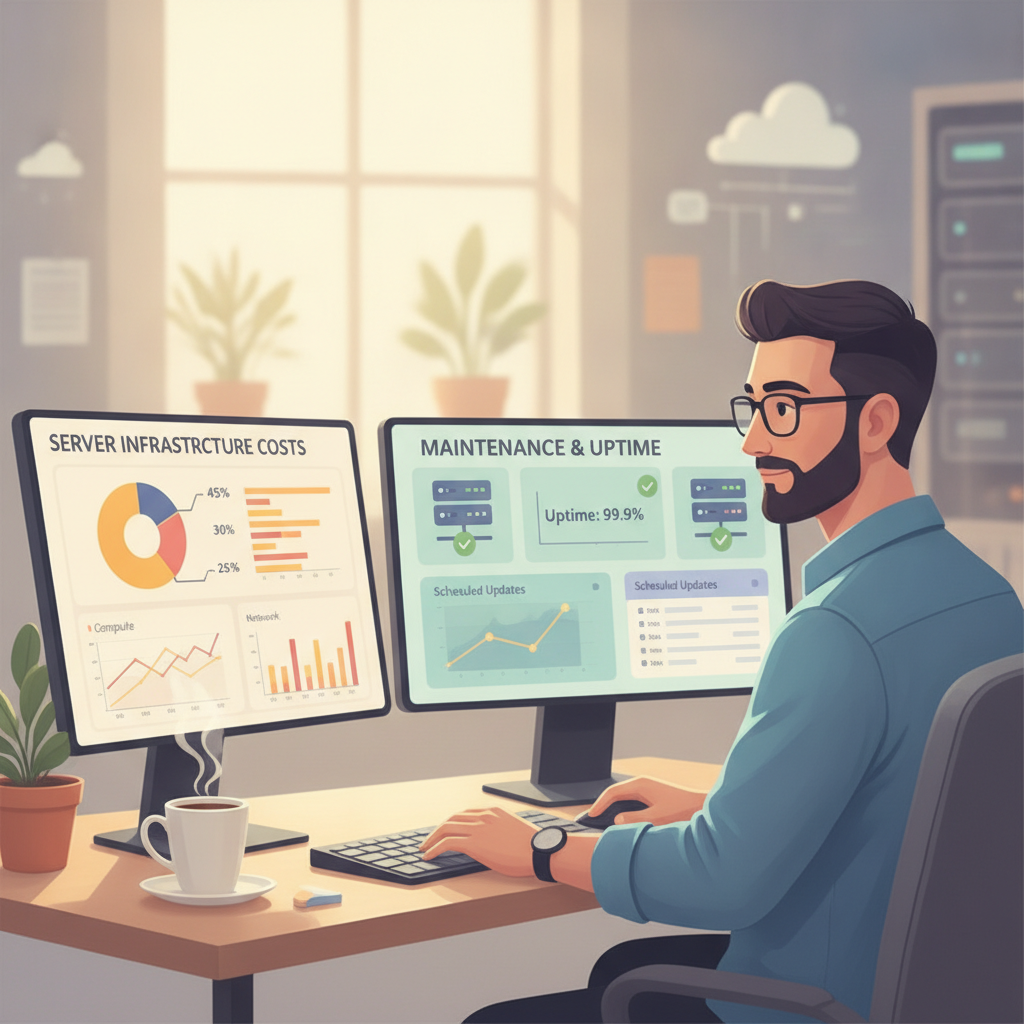
Software is not a static physical product. It operates inside a changing ecosystem of browser updates, mobile operating systems, dynamic libraries, and evolving security standards. According to IEEE Software Engineering studies, post-launch maintenance represents 60% to 80% of a software application's total lifetime cost of ownership [1].
Baseline engineering standards dictate that annual SaaS maintenance costs run between 15% and 25% of the original build budget [2]. For a $100,000 MVP build, founders must budget an additional $15,000 to $25,000 line item every single year simply for:
- Dependency and security vulnerability updates
- Critical bug fixes and regression testing
- Operating system and database updates
- Basic uptime monitoring and server health checks
Failure to plan for these recurring operational line items explains why 92% of SaaS startups fail within three years, with 45% collapsing during the 18 to 24 month post-launch period as cash flow crises strike [4].
Scaling Costs: Third-Party APIs, AI Inference, and Architecture
As your customer base grows, your infrastructure expenses scale along with it. Modern SaaS platforms rely heavily on third-party integrations for messaging, payment processing, transactional emails, mapping, and authentication.
Financial analysis of SaaS integrations shows that third-party API and platform service fees scale from $50 to $200 per month pre-launch to $2,500 to $8,000 per month once a platform reaches 10,000 active users [6]. These variable recurring costs directly erode gross profit margins if pricing models are not structured correctly.
Furthermore, integrating AI agents and custom Large Language Model (LLM) workflows introduces token consumption expenses. Operational inference fees account for 30% to 50% of first-year total cost of ownership for AI-native applications [7]. For example, a customer support AI agent handling 10,000 monthly conversations consumes approximately 15 million tokens, generating $750 to $1,500 in recurring monthly API token costs alone [7].

Architectural choices made in early scoping also carry massive financial consequences. Choosing the wrong multi-tenant database isolation strategy during initial scoping leads to 6 to 12 months of forced technical re-architecture once a platform reaches 500 paying customers [8]. Early decisions meant to save build costs lead to expensive forced database rewrites when enterprise buyers demand custom security and strict data isolation [8].
Compliance and Customer Acquisition Expenses
Building enterprise-ready software requires strict adherence to security and privacy frameworks. Continuous security compliance and mandatory annual audits, such as SOC 2 Type II, HIPAA, and GDPR documentation, add $20,000 to $70,000 in annual fixed operational expenses [9]. Meeting buyer security mandates requires ongoing penetration testing, evidence collection, and log monitoring that cannot be deferred without forfeiting major enterprise deals [9].
At the same time, distribution costs have skyrocketed. Acquisition statistics show that average B2B SaaS customer acquisition cost (CAC) has increased by over 60% in recent years, reaching $702 per customer [10]. Founders who spend their entire runway on application code lack the remaining capital needed to fund marketing channels and user distribution [10].
At About AppBrewers, we help startups build lean, production-grade applications that avoid unnecessary feature bloat and technical debt. Discover our thoughts on software architecture in our related articles.
How to Prevent Post-Launch Cash Flow Crises
- Scope strictly around high-impact features: Audit planned features so you build only the 12% that drives 80% of daily engagement [3].
- Budget for annual maintenance from day one: Reserve 15% to 25% of your initial development cost annually for ongoing maintenance [2].
- Plan multi-tenant architecture early: Choose scalable database isolation before reaching 500 paying customers to avoid forced rewrites [8].
- Factor in third-party API and AI token consumption: Account for scaling API and LLM token costs when pricing subscription tiers [6], [7].
- Allocate sufficient capital for distribution: Ensure remaining cash reserves can support a B2B customer acquisition cost averaging $702 per user [10].
Frequently Asked Questions
What is a realistic SaaS development cost breakdown?
A realistic breakdown includes base feature development, 40% to 60% overhead for QA, DevOps, and design polish [5], annual maintenance running 15% to 25% of the build cost [2], scaling third-party API costs [6], and marketing distribution budget to cover a $702 average B2B CAC [10].How much does ongoing SaaS maintenance cost annually?
Standard engineering benchmarks establish that ongoing annual maintenance costs run between 15% and 25% of the original SaaS development budget [2]. For a $100,000 initial build, expect to spend $15,000 to $25,000 yearly for bug fixes, operating system patches, and dependency updates [2].Why do so many SaaS startups fail post-launch?
Data shows 92% of SaaS startups fail within three years, with 45% collapsing between 18 and 24 months [4]. This primary cause is cash flow exhaustion caused by unexpected maintenance costs, scaling API fees, and high customer acquisition expenses [4], [6], [10].How do AI features affect ongoing SaaS operational expenses?
Integrating custom LLMs and AI agents introduces token consumption fees that account for 30% to 50% of the first-year total cost of ownership [7]. A customer support AI agent handling 10,000 monthly conversations can generate $750 to $1,500 in recurring monthly token costs [7].How does feature bloat impact software development budgets?
According to research by Pendo, 80% of software features are rarely or never used [3]. Building non-essential functionality inflates initial engineering expenses and creates long-term maintenance debt for code that delivers little business value [3].How do third-party API fees scale with SaaS growth?
Third-party API and platform fees typically start at $50 to $200 per month pre-launch but quickly scale to $2,500 to $8,000 per month once an application reaches 10,000 active users [6].Sources
- adevs.com — https://vertexaisearch.cloud.google.com/grounding-api-redirect/AUZIYQF__MQW74Z9qq5Z8N1nUxwvoNmFwYDI4k62O25wo6MaLC9P6CXOlmdAEhHQThzy5ImL44kFxu4DNoC3xodTapNEDTjdFwkUFO_IUFsgvhXm9CoIbxVaYknOsgkQRthuPEYpNlLjGQ_19w==
- geeksforgeeks.org — https://vertexaisearch.cloud.google.com/grounding-api-redirect/AUZIYQHH9RtjXWOkcnWvE4xqBEeTyv51eAFGUZ1gJwEiSL3iuGJWbrAk0jya0bTzpOSXuZW9Q1_oHhwX3zrCCoSDFCNQzshIa_tfMu_ZawyEkKqKL26BNB2Xfbis68weid1Javzac0ESHUkxF0pkpQ5-1XewXB2o64nc1mPK7tqdZMfnBH8yusnxltsxxsO-JdWfKk2Xlg==
- savibm.com — https://vertexaisearch.cloud.google.com/grounding-api-redirect/AUZIYQGY2XAO7R_fwuKny2jZVAXCkejBaxDoFDg_GqoIdhroy85VHJC-1s9CfXh4uFxaIaAozX48-czJ1hX8fVSKljvlLvpuRNNQbsPsLIEdg9t9wtKIqVJUhOTmdc9_Mw5EqPHMF2_qOuWMRu0=
- emergen.io — https://vertexaisearch.cloud.google.com/grounding-api-redirect/AUZIYQE1fpPWI3PLnlhTxPBLzEHvzy5NnsZpfWvtjEtdZj44fgaptfm9pzLfvJ4eT4YXBW4scyFe523JFoxS8MzSe8VbXCtarlPiw8vf0OODaBI6n-WKkN8xaIADKSx_RQUt-4p-E1F5jglmdICASe6wdZyrWgin2FNy7LwXuNpdPlcCCChY7uCbBcl17dddMD7Vw80dvPWOI-0UhebK3Rc=
- rorixtech.com — https://vertexaisearch.cloud.google.com/grounding-api-redirect/AUZIYQHjTgYJ1lKrd71iS2COfy05Y5m_NDDe70vL10vp-4R9-jTGq4Ei9XYj8qcOqMeHJnrIaCQ1lne1Ks2cR0ucaJDcjJnyWNp9tlkiq0ifEVZe8WcG8-Ahknl3xPb4bvg1Bg6BJ2gElpKHC5RA_mw93S2nJxkF9gSgh8I=
- mvpdevelopment.company — https://vertexaisearch.cloud.google.com/grounding-api-redirect/AUZIYQEIY199XMpNHmg95JNHh7ALIFm79ezZsPt1ARI0eV87qMuagRMC3Z_dduQqNyQZnHYhNK_4cOs0HMXJccgWzc4guXY1aqHw4giq0xs0JRrcE3ImyN5GSNwB4_kyteCY_E-RsCuJ66axd6PScpza
- saasfractionalcpo.com — https://vertexaisearch.cloud.google.com/grounding-api-redirect/AUZIYQEq3wak9lH7w8UaRTXTiciMHfhh-xLHTa8fU1tdN3VkPpe0tB1UKuJjGG-AAPKj9lOMjSKxES_kqw5xjtYroISKTpbLlBY1lMsDNiYm_rdDUwcxhmZxTmaByWaUZjI-4FSI8wp0poG9XhiDAsf4y3wWBhuKCg==
- rockingweb.com.au — https://vertexaisearch.cloud.google.com/grounding-api-redirect/AUZIYQGVH1CeKp0kl51RKes1LQVDjiFblja78NMGUFHLWyxkiUBnTkPUhhtFZHWiGkL9fF9UBxvvxxGdDdWlNaVcZLjxXyYcRfRjI17-slhQc95Qu4GJBfc_cGf9fVSzOO-J10fJVWUI-3sQNHdQqxgXyMROCbMSD94u-HGhCyP1Cbk5avdasKP9JQ==
- arielsoftwares.com — https://vertexaisearch.cloud.google.com/grounding-api-redirect/AUZIYQGWrZLqneQFTQ34BEVGxQF5asebdneI-Qf8wbmXmVPQhn6qRzFgttNNf47rGIkgX8kVrIL_sCgJoKrJZ8Ri_UImHPSDii2W8PIb9K99oOg28-AqUOLMDpOmpggVLNWgGa27vGKmS2rDna7iPYAmcAAoL-q3W5JEdG4lWyM=
- decipherzone.com — https://vertexaisearch.cloud.google.com/grounding-api-redirect/AUZIYQHw_ctXVmnsPhlcOZV5nnK2dmugOr3V506eKWsZ68mAklY0G9Kek_xrFaoVGw7jY5peS5PWqOLsYP_8mkpktKG7sNaNYOUgoFrSSbCgePUa3rXtLKVrzV3-DPQWWuuIO5RXG46Zu-t4_roIWKKIeM-g03LaDp-XCA==
David Friedman — Founder & Lead Engineer, AppBrewers · LinkedIn
David Friedman founded AppBrewers to turn agentic AI into shipped software. He builds the infrastructure that automates app creation and deployment, so products go from idea to production in weeks, not months. He is also the builder of Conversify, an AI communication platform for service businesses. Based in Malta, serving clients across Europe, the US, and the UK.