
SaaS DevelopmentSaaS BudgetingApp Development CostTech Stack TCO
How to Calculate Real SaaS Development Cost Without Overpaying
Calculating SaaS development cost requires looking beyond initial coding hours. This guide breaks down hidden infrastructure, API integrations, compliance, and maintenance fees to help you budget accurately.
Published on August 19, 2026 · Updated on August 19, 2026
How to Calculate Real SaaS Development Cost Without Overpaying SaaS development cost refers to the total capital required to design, build, test, and launch a software-as-a-service application. While base build costs vary, a complete product requires factoring in design, QA, and post-launch maintenance, which typically add 40 to 60 percent on top of the initial development quote [2]. For instance, an initial 80,000 dollar development estimate frequently balloons to 130,000 or 150,000 dollars once these essential phases are integrated [2]. To calculate your actual budget, you must also account for regulatory compliance, which adds 15 to 25 percent to core costs [3], and post-launch operations that run between 2,000 and 8,000 dollars per month [9]. By leveraging modern AI-powered development tools, founders can now compress traditional development costs by roughly 60 percent [5]. Understanding these variables is critical for budgeting accurately before seeking a partner to build your application. If you want an accurate, transparent estimate tailored to your unique product vision, you can get a quote from our team at AppBrewers.0 billion dollars in 2026 [1]. It is expected to continue growing at an annual rate of 19.38 percent from 2026 to 2029 to reach 793.10 billion dollars [1]. This massive expansion is pulling thousands of new products into the market. To survive, founders must manage their budgets carefully to avoid running out of runway before finding product-market fit. Unfortunately, many first-time founders fall into the trap of only budgeting for core coding hours. When you receive a proposal from a traditional software development agency, the quote often covers only the base build. However, design, quality assurance (QA), DevOps, and post-launch maintenance typically add 40 to 60 percent on top of that base build cost [2]. If you receive an 80,000 dollar quote for coding, the real price to launch will easily reach 130,000 or 150,000 dollars once those essential phases are factored in [2]. Furthermore, the real Total Cost of Ownership (TCO) of a SaaS stack is typically 3 to 5 times the subscription fee alone [4]. This is due to the hidden costs of integration, customization, risk, and opportunity costs that multiply as your business scales [4]. To read more about how to navigate these early-stage tech decisions, check out our related articles. 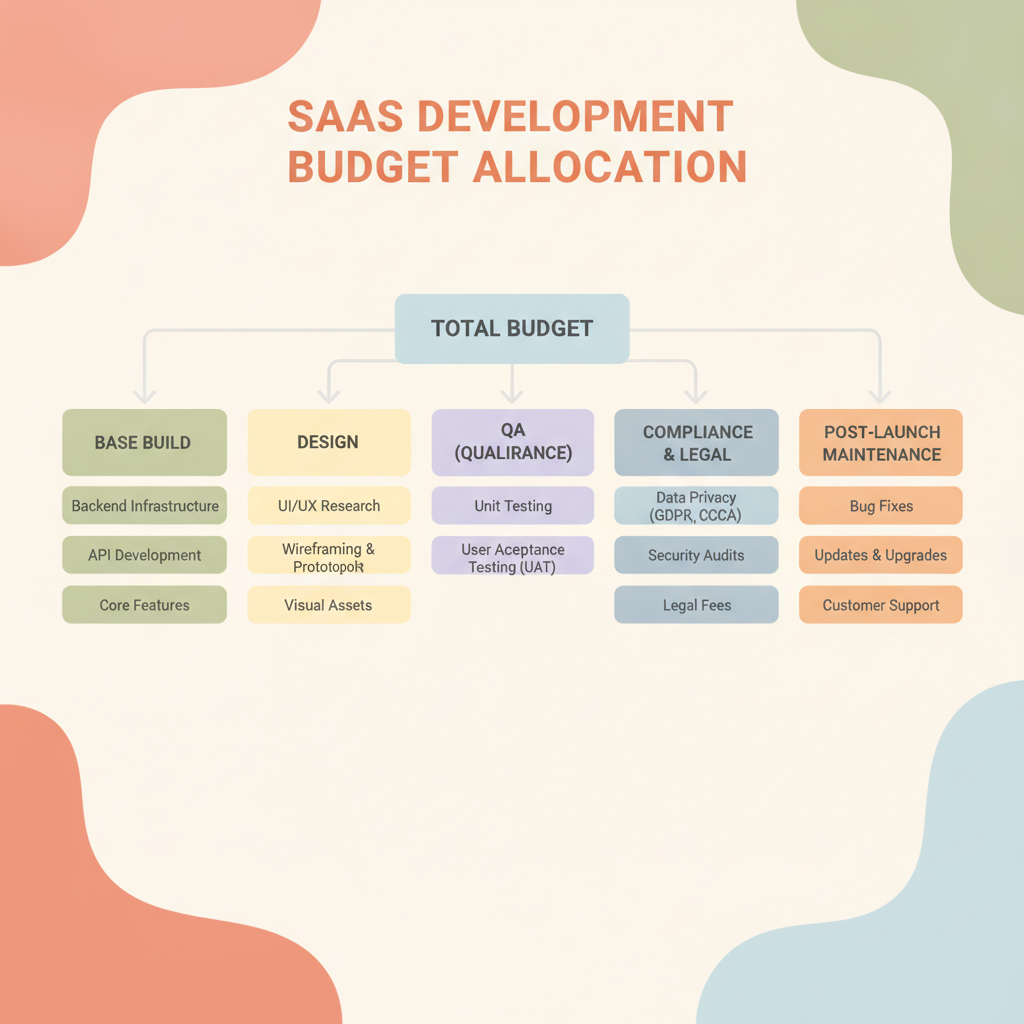 ## What Are the Hidden Infrastructure and API Integration Costs? Generic online calculators often ignore the heavy engineering lift required to build reliable third-party connections. Building a single custom API integration with proper error handling, authentication, and data mapping typically costs between 25,000 and 65,000 dollars to build initially [7]. This process requires 4 to 8 weeks of senior engineering time [7]. Even worse, integration costs do not stop at launch. Maintaining active API integrations requires an estimated 1 to 2 weeks of engineering time per integration annually [7]. For a scaling company with a portfolio of 15 integrations, this can accumulate to 15 to 30 weeks of work per year [7]. This represents a massive hidden cost and opportunity cost, pulling your developers away from building your core product features. Another major cost driver is the demand for modern, interactive features. Real-time data features, such as live dashboards, streaming, and real-time collaboration, cost 3 to 5 times more to build than static data features [10]. Real-time capabilities are one of the primary technical drivers that push a SaaS project from a simple Minimum Viable Product (MVP) tier into a highly complex, full-featured application.
  ## How Much Do Security and Regulatory Compliance Add to the Budget? If your SaaS application handles financial, health, or personal data, you cannot afford to skip regulatory compliance. Meeting strict standards like GDPR, HIPAA, SOC 2, or PCI-DSS typically adds 15 to 25 percent (or an extra 20,000 to 50,000 dollars) to a SaaS project's core development budget [3]. These standards require significant upfront engineering time and ongoing audit costs, which are much cheaper to build in from the start than retrofitting later. Additionally, security is an ongoing operational requirement. SaaS providers typically allocate 15 to 20 percent of their operational budgets to security programs and infrastructure [11]. Ongoing security monitoring, penetration testing, and vulnerability patching are critical to protecting user data but are frequently left out of initial development estimates. ## How Does AI Technology Reduce the Cost to Build SaaS? Fortunately, the rise of modern AI technologies has completely shifted the economics of software development. AI-powered development tools and coding assistants have compressed SaaS development costs by roughly 60 percent compared to traditional agency builds [5]. By automating boilerplate code, user interface generation, and QA testing, a single senior developer can now ship features in a conversational loop that previously required a team of five. At About AppBrewers, we leverage this agentic AI infrastructure to build high-quality web and mobile applications in a fraction of the time, passing those massive savings directly to our clients. If you want to build custom AI features directly into your application, the costs are also more manageable than ever. Integrating a commercial Large Language Model (LLM) via API into a SaaS product typically costs between 5,000 and 30,000 dollars for a focused feature, with ongoing API costs ranging from 0.15 to 15 dollars per million tokens [8]. This approach allows modern SaaS companies to add powerful AI capabilities without the massive overhead of training custom models from scratch.
  ## How to Calculate Your Real SaaS Development Cost Step-by-Step To build an accurate budget, you should follow this step-by-step process: - Step 1: Estimate the core development hours. Work with a development partner to map out your core feature set and estimate the initial coding hours.
- Step 2: Add 40 to 60 percent for essential phases. Factor in the costs of UI/UX design, quality assurance, DevOps setup, and post-launch maintenance right from the beginning [2].
- Step 3: Add compliance and security buffers. If you need to meet standards like GDPR or HIPAA, add 15 to 25 percent to your core development budget [3], and allocate 15 to 20 percent of your ongoing budget to security [11].
- Step 4: Budget for integrations and real-time features. Allocate 25,000 to 65,000 dollars for each custom API integration [7], and multiply your feature estimates by 3 to 5 if you require real-time data or live collaboration [10].
- Step 5: Project post-launch monthly operational costs. Do not budget per year; expect post-launch operating costs (including hosting, third-party services, and maintenance) to run between 2,000 and 8,000 dollars per month [9]. By following this realistic budgeting framework, you can ensure your startup has enough runway to find product-market fit and scale successfully. ## Frequently Asked Questions ### What is the average post-launch operating cost for a SaaS platform?
- arielsoftwares.com - https://vertexaisearch.cloud.google.com/grounding-api-redirect/AUZIYQEY5kUYHjwpS_6S5hSGTi4WZEISs4TqJpt_4X9i7-4KgZbTLy8WjSq84ZOq1b_IVQTJZshqUNZVQOjqBRudz0bV5Jbpswqe6mjdJXh7c1RGBEcfUqk7BajY1-6vFtbkvUL7vgEqyJTiTRQj9p67gJurpxRz6fsT3n5T99A=
- blockchain-development-solutions.com - https://vertexaisearch.cloud.google.com/grounding-api-redirect/AUZIYQF6WJIXFswVjU06Trhzal_OGn-wUdOOz-bEmB8Y8T4AYyWHXU0_F7L8CAXtsLj3dS5YABEq4pMYTOznIGWUud77bKpaY14JM_dyvd8zqKOiiChTNe-w539Nv8Q5yHkp5EoPiSnqyaZlQpATpL9divRRS-PwqaH5tfGPHojnJGlmxnmkDA==
- valueans.com - https://vertexaisearch.cloud.google.com/grounding-api-redirect/AUZIYQHM2kuFHoBuMgjHm-arIftBlfLjIoGcz-HFKfSK911zOyMUX2yRMLk42dAx9kHMO_xA4kIlQauWwTH4xrJkTZw_3GnVGGk7xKNMM2HWfwEXkHhFE62cSC6n1KNzTaZKST0=
- hatchstudio.ai - https://vertexaisearch.cloud.google.com/grounding-api-redirect/AUZIYQFYmmuicu6-n5QpdwJpJUnd2FCpwbQX_ONS7PB1_YhRO4VKzrlNTHE409xDzLuIFwEE8ssehgyjED_yWosmAhYRE3C-RE3tFOvwWI8hN4HDGjHBy0sXKVJN2qXRa_zLnkNo-nA=
- bindbee.dev - https://vertexaisearch.cloud.google.com/grounding-api-redirect/AUZIYQGLDE2rdbMFHY1xHAfjemZtJus5um0-E86kXr2RQ3FAE9v2hfurvEBWbE4ETRyyUbWxaMsgfoAUu-_X7EZ_7OcwXOLKhXBngbmy-fgzfruzHHQwk9kNoawcUm2IguKndJ0xtqY=
- nikhilgarg510.com - https://vertexaisearch.cloud.google.com/grounding-api-redirect/AUZIYQFNUoyhW-urqi9abrSFPcEBkdFRnLHLJo901xNjK7UVw7LZl9zJGZBU4-Bel67rEgCWCaelLYcVOom_p43M8pbFv0a-xF4wvSC8qLPDkJyZUkl8CZjdj-fTdrQBNGl-ra2raY0jbeCRkNErsBzBf_GIADykvsjORL6A7aPBTyb9qZbQtKoTgKsCjB3OqU7T-IxqXtqGZXoVOQ==
- saaslaunchlab.com - https://vertexaisearch.cloud.google.com/grounding-api-redirect/AUZIYQH3PkKQg6s37fGFKgmznmjSWgL6ibAncS6eKKpIEybNYlsu5zXP4on4FTycfIx5X8tN-3JROV5elRZjZB2eT1OOZ3fp2msSrAxwCgo2RxM-z7sdOjO_71GWIi8BHYjSG3_AC_Aps6LnaA==
- raftlabs.com - https://vertexaisearch.cloud.google.com/grounding-api-redirect/AUZIYQGfHApQFgg3YGacJHuITnWamQiRKVeb6y67DsuiBGSiW_cayxt7Ssm1bjdOPzX30x0tkhSm8DcfsZQQc0IgDr1RCBJJEtpIAMG4oK7geOSixm5_XdivVNd6mqi1xVHgO5blEb-4Cyv2JXGuOPRu
- gainhq.com - https://vertexaisearch.cloud.google.com/grounding-api-redirect/AUZIYQGPRy7yUUTMblFHQ7AEPHoXh8EqxGx3z7tc-BTJKEddCCLDDBXN-w9a84xCpizZyAyh-lw8A7qJZOMnERDvZjzXq9_QkfqhGwg0_M331jZM_1iqDVXStB1qVMZE5pqzD5EC4wl0EzOV
D
David Friedman — Founder & Lead Engineer, AppBrewers · LinkedIn
David Friedman founded AppBrewers to turn agentic AI into shipped software. He builds the infrastructure that automates app creation and deployment, so products go from idea to production in weeks, not months. He is also the builder of Conversify, an AI communication platform for service businesses. Based in Malta, serving clients across Europe, the US, and the UK.