
React NativeFlutterPerformance BenchmarksMobile Development
React Native vs Flutter: 2026 Performance Comparison
A comprehensive, data-driven performance teardown of React Native vs Flutter in 2026. Discover which framework wins in cold start times, rendering speed, memory, and CPU usage.
Published on August 21, 2026 · Updated on August 21, 2026
React Native vs Flutter: 2026 Performance Comparison Choosing between React Native vs Flutter depends on your app's performance needs. In 2026 benchmarks, Flutter outperforms React Native in speed, clocking a 0.82-second cold start on iOS compared to React Native's 1.04 seconds [1]. However, React Native leads in memory efficiency, consuming 155 MB during scrolling versus Flutter's 273 MB [6]. This performance divide stems from architectural differences. React Native relies on the Hermes engine and JavaScript execution, which integrates deeply with native UI components but introduces communication overhead [1, 7]. Both frameworks offer massive business value, reducing mobile development costs by 30% to 60% compared to native builds [4]. ## How Do Cold Start Times Compare on iOS and Android? Cold start performance is critical for user retention. In a 2026 cold start benchmark of a product catalog application, Flutter 3.27 launched in 0.82 seconds on an iPhone 15 Pro, whereas React Native 0.77 required 1.04 seconds [1]. This performance gap is primarily due to Flutter's Ahead-of-Time (AOT) compiled Dart binary loading faster than React Native's Hermes engine and JavaScript bundle initialization [1]. The performance gap widens on budget-friendly hardware. On a mid-range Samsung Galaxy A24, Flutter's cold start time was measured at 1.62 seconds, compared to 2.18 seconds for React Native [2]. This benchmark demonstrates that the startup performance gap between the two frameworks widens on lower-end hardware where CPU resources are more limited [2]. 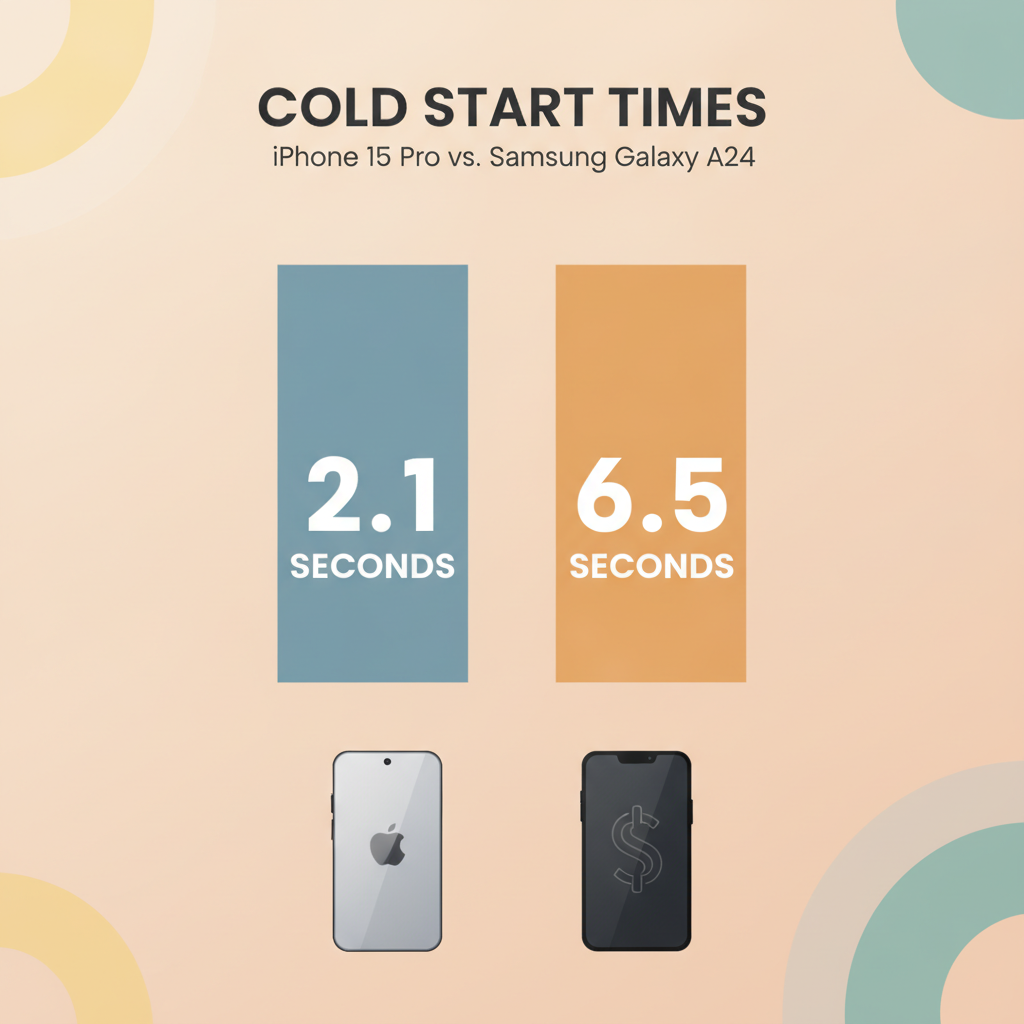 ## Frame Rendering and Display Budgets at 60 Hz and 120 Hz Smooth animations require consistent frame rendering times that stay well within the display's refresh rate budget. ### 60 Hz iOS Rendering Performance
During a 60 Hz frame rendering test on iOS, Flutter achieved an average frame rendering time of 1.72 ms, while React Native averaged 16.65 ms [3]. Flutter's custom rendering engine provides substantial headroom under the 16.7 ms frame budget, whereas React Native operates right at the limit of the display's refresh rate [3]. ### 120 Hz Android Rendering Performance
On a 120 Hz Android display with an 8.3 ms frame budget, Flutter averaged a frame rendering time of 4.01 ms, utilizing only 48% to 61% of the budget [4]. This efficient rendering allows Flutter to maintain smooth, high-refresh-rate animations, while React Native struggles to consistently stay under the tighter frame deadline [4].  ## Memory Consumption and the Impact of Impeller While Flutter wins on raw rendering speed, React Native's reliance on platform-native UI elements gives it a distinct advantage in memory management. * Memory Footprint during Scrolling: In a Samsung Galaxy A54 benchmark of a ListView application, React Native consumed an average of 155 MB of memory during scrolling, whereas Flutter consumed 273 MB [6]. While Flutter excels in rendering speed, its custom engine overhead typically results in a larger memory footprint compared to React Native's use of platform-native UI components [6].
Impeller Optimization on iOS: Flutter's newer Impeller rendering engine reduces memory consumption on iOS by approximately 100MB compared to its older Skia engine [5]. This architectural upgrade eliminates runtime shader compilation jank and significantly improves memory efficiency on mid-range devices [5].
## Memory Consumption and the Impact of Impeller While Flutter wins on raw rendering speed, React Native's reliance on platform-native UI elements gives it a distinct advantage in memory management. * Memory Footprint during Scrolling: In a Samsung Galaxy A54 benchmark of a ListView application, React Native consumed an average of 155 MB of memory during scrolling, whereas Flutter consumed 273 MB [6]. While Flutter excels in rendering speed, its custom engine overhead typically results in a larger memory footprint compared to React Native's use of platform-native UI components [6].
Impeller Optimization on iOS: Flutter's newer Impeller rendering engine reduces memory consumption on iOS by approximately 100MB compared to its older Skia engine [5]. This architectural upgrade eliminates runtime shader compilation jank and significantly improves memory efficiency on mid-range devices [5]. 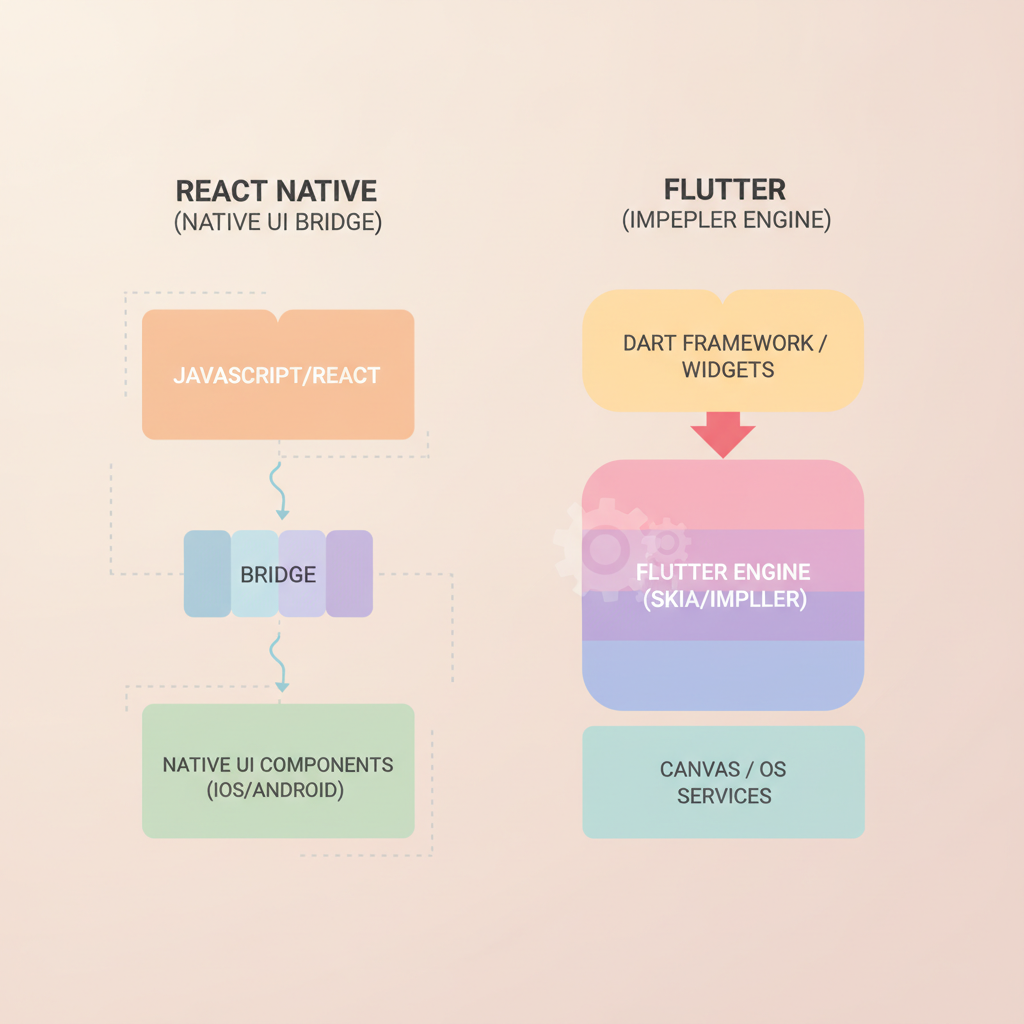 ## CPU Overhead and Bridge Serialization Active user interactions, such as scrolling complex lists, tax the device's processor differently depending on the framework's architecture. During active scrolling of a ListView application on a Galaxy A54, Flutter maintained a lower average CPU usage of 11%, compared to React Native's 16% [7]. React Native's higher CPU utilization is often driven by the serialization and deserialization overhead required to pass data across its bridge or JavaScript Interface (JSI) [7]. ## Time to First Frame: Flutter vs Native Swift One of the most surprising findings from 2026 benchmarks is how Flutter compares to native iOS development. Flutter achieved a Time to First Frame of 16.67 ms on iOS, which is roughly 2.5 times faster than native Swift's 41.37 ms [8]. This rapid rendering is made possible by Impeller's ahead-of-time shader compilation, which prepares GPU assets before the application launches [8]. ## Market Share and Development Cost Efficiency Choosing a framework is not just a technical decision; it is also a business strategy. Developer Adoption: As of 2026, Flutter holds approximately a 46% market share among cross-platform mobile developers, while React Native powers about 35% to 38% of cross-platform apps [2]. Despite Flutter's lead in developer usage, React Native remains highly popular due to its deep integration with the massive JavaScript and React web ecosystems [2].
- Financial Savings: Both React Native and Flutter offer substantial development cost savings, reducing overall expenses by 30% to 60% compared to building separate native iOS and Android apps [4]. Flutter often yields slightly higher savings (40% to 60%) due to faster MVP timelines, while React Native (30% to 50%) benefits from a larger, more readily available talent pool [4]. ## Framework Comparison Table | Metric | Flutter (2026) | React Native (2026) | Winner |
| :--- | :--- | :--- | :--- |
|---|---|---|---|
| iOS Cold Start (iPhone 15 Pro) | 0.82 seconds [1] | 1.04 seconds [1] | Flutter |
| Android Cold Start (Galaxy A24) | 1.62 seconds [2] | 2.18 seconds [2] | Flutter |
| 60 Hz iOS Render Time | 1.72 ms [3] | 16.65 ms [3] | Flutter |
- pixelseed.net — https://vertexaisearch.cloud.google.com/grounding-api-redirect/AUZIYQG2xwoV5xwdjVEM-n1eIngJQgTN1N0UYOdvOM771NvpWTgZQFB8YaZBxcaCl-4yM9lLSEP0mQNTzk-HDgw02zkL-fX2aV_7y-9JQDZ8mUYL3aKT1ka-XyX5LvrL0K6hCionx7uMpH57Lr_bEyfhfhofI65wpMZYpl_TaFwWZM8eYw8YpMZDQamqMvikakT47FJn1RQPVA==
- medium.com — https://vertexaisearch.cloud.google.com/grounding-api-redirect/AUZIYQF96fCveMNJLXZeDx1hCT0xWs1xnJgHyBnwAyiykfqVKJm0qqHtTUZRKZWObIZD1zpjJ-gxG92BnhXbKOW9eJOM4bQTPuvwZi7SzTuNW8jJVFPQJKmfmLB9Himo8HJgNoITH60J111PSoG2Kionv0E_vv38bz3_HE1TEwHDjD0JSgTyUBvZXqLXMGLZgpcXSJAkIkZ83qxaw_ouYeS448LCqh_w6Q==
- agilesoftlabs.com — https://vertexaisearch.cloud.google.com/grounding-api-redirect/AUZIYQHWLjmOzhONcNOFBdq0Mge_R22hWhfBTrdQcnfG3eTxTUL9Xt7E2_SIZ-cXJgb7dX7kQSmqy2Uy-ri4MCmANQwen5vI-jyIa7N6NWPIeThPPHuHxOE537lWvM3UHHRPEL9R_WT81TWS8vCC6Ru5LQqUQKW-3W9qW_70q08O5xN2RoFjlapVI88i
- agilesoftlabs.com — https://vertexaisearch.cloud.google.com/grounding-api-redirect/AUZIYQHWLjmOzhONcNOFBdq0Mge_R22hWhfBTrdQcnfG3eTxTUL9Xt7E2_SIZ-cXJgb7dX7kQSmqy2Uy-ri4MCmANQwen5vI-jyIa7N6NWPIeThPPHuHxOE537lWvM3UHHRPEL9R_WT81TWS8vCC6Ru5LQqUQKW-3W9qW_70q08O5xN2RoFjlapVI88i
- reddit.com — https://vertexaisearch.cloud.google.com/grounding-api-redirect/AUZIYQHdxJSF3MiZuUb2AKyBH0yAuXBhtzGjr9k6jMBNrIcT_0AjySGwzBUaY_Z_qgMYV1_77z0KAbHQ_VqSYpl00_2u2Gruk2v4EWt7syTbZHQjg2cdT1W0TZmE8bS6Y7J3ntt2oluL9SlFWBpgdIrwMSQmZz7ycOLAJy0Joo50Y_Wl83tnpYB1j5yJ1CAkJkrppx6-VoooC3iXGUMAaQ==
- inveritasoft.com — https://vertexaisearch.cloud.google.com/grounding-api-redirect/AUZIYQHkkt0YDUbaqfP-IwX7gjFp_6DijIozi5bMPabrv7aSmioqmKvJRn8YFXiv1zCNK-4edHePEC_fcgccQjL4EkT1a0jv7ZiMDUinJ6_2ieosfi6Px_ZsCLKPL4hIAn0VCxKo4f5XFPjqWVE2b-vLCrL1KxYyQ6YSbu52S6th7izWGWrIJhVFs6YVjPiaoygHjc6o
- adevs.com — https://vertexaisearch.cloud.google.com/grounding-api-redirect/AUZIYQF-YUfavIua-4MIaOlZ2tQZNLwJfbDsWTr1ggCFL28mmXEbi8wtdiXvINXwzy460igpTBPxukcanShfQVQaud3GJEZogaQKRcPmy180UKG2c58FEz0liiXmG3cC9e-os6Wmf6tJ5Q==
- gitconnected.com — https://vertexaisearch.cloud.google.com/grounding-api-redirect/AUZIYQEn7NisIa1DO8uxcXrsjcMxBhhyLdGdWKL7bJxSp-KNI9evEY6ba-9hGnztDqHGkNM5K05aXjmY6atvZ6V92xymDndf2erfnbjNr3LsEqqNfVe9PLkYkwfp2Ie24QzwGuRaY7GJkH5V2CT-vR4iCP346tq7sP6f6UmDToVjXwGd-QlZRlhRhq75JJZDOLtou4Z1NQlwgE9wdO9fmKR7lfeFqeh-xkOEUur44pqumA== ## Conclusion
D
David Friedman — Founder & Lead Engineer, AppBrewers · LinkedIn
David Friedman founded AppBrewers to turn agentic AI into shipped software. He builds the infrastructure that automates app creation and deployment, so products go from idea to production in weeks, not months. He is also the builder of Conversify, an AI communication platform for service businesses. Based in Malta, serving clients across Europe, the US, and the UK.