React Native vs Flutter MVP Cost: 2025 Comparison Guide
Discover how React Native and Flutter stack up on MVP cost, build timelines, developer talent availability, and performance to make the right choice for your 2025 mobile app launch.
Published on October 12, 2026 · Updated on October 12, 2026
React Native vs Flutter MVP cost comparisons show that cross-platform development cuts overall building expenditure by 30% to 60% compared to native iOS and Android applications [1]. Building a basic cross-platform MVP costs between $15,000 and $50,000 overall, with typical Flutter builds estimated at $30,000 to $50,000 and React Native builds ranging from $35,000 to $55,000 [3]. Flutter leads global developer usage at 46% market share compared to 35% for React Native, primarily due to its faster 12 to 16 week MVP delivery timeline [3].
However, React Native maintains a clear edge in hiring availability, showing over 6,000 U.S. LinkedIn job postings versus roughly 1,000 for Flutter [5]. JavaScript powers React Native and boasts 62% global adoption, whereas Flutter uses Dart, which is known by only 6% of developers [5]. Additionally, React Native links directly to over 2.1 million npm packages compared to 48,000 on Flutter pub.dev [10]. Both Google and Meta backed frameworks command over 80% of the cross-platform market [2]. If you want to check custom project estimates, you can get a quote from our European development studio.
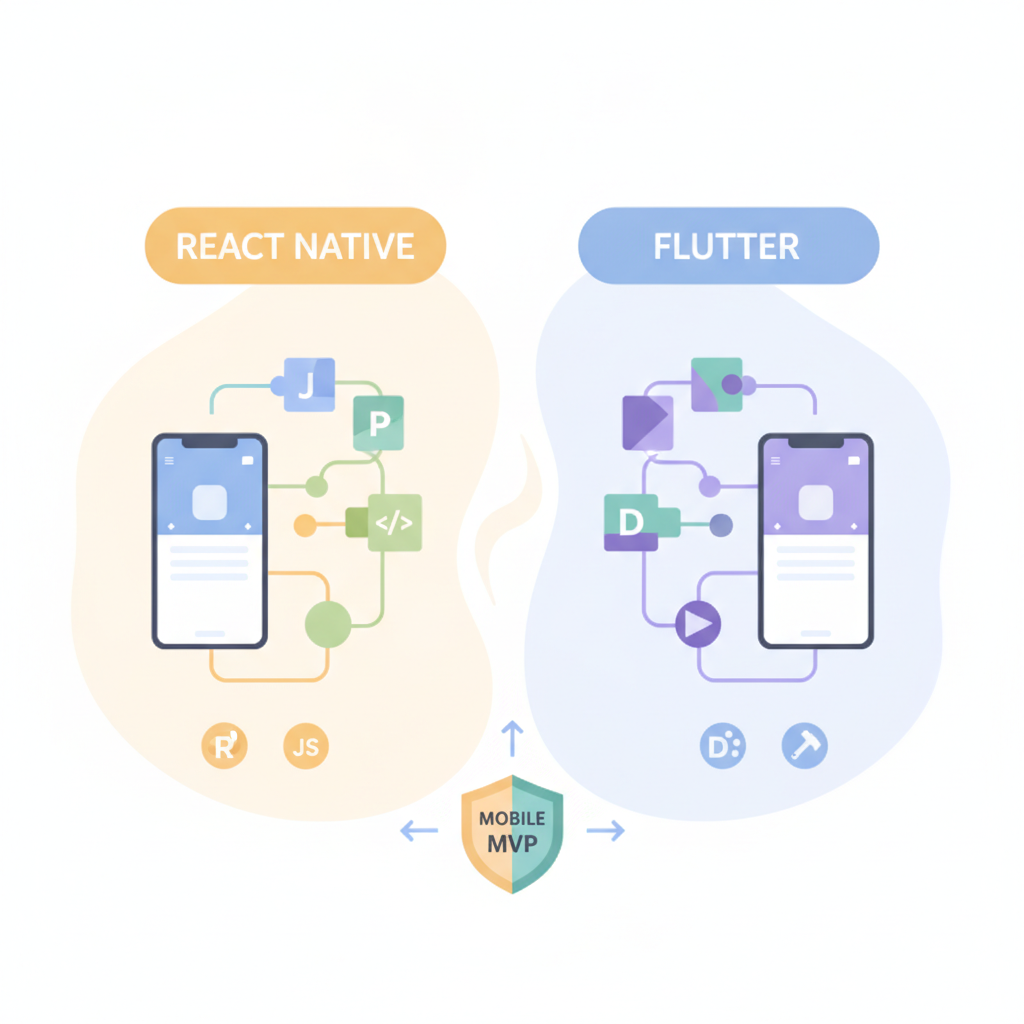
What Is the React Native vs Flutter MVP Cost and Timeline Breakdown?
When evaluating cross-platform options, understanding direct labor hours and budget allocation is essential for startup founders and engineering leads. Selecting a unified framework eliminates the need to maintain duplicate iOS and Android teams.
- Initial MVP Expenditure: Typical Flutter MVP projects cost between $30,000 and $50,000, whereas React Native MVPs average between $35,000 and $55,000 [3]. Basic entry-level cross-platform builds can start as low as $15,000 depending on core feature scope [3].
- Development Timelines: Flutter projects typically take 12 to 16 weeks to reach initial market launch, while React Native builds average 14 to 20 weeks [3].
- UI Prototyping Velocity: Flutter speeds up early design phases thanks to sub-second hot reload cycles of 0.4 to 0.8 seconds, compared to 1.2 to 1.8 seconds for React Native Fast Refresh [9].
- Budget Reduction Efficiency: Building one unified codebase yields a 30% to 60% savings in initial development and ongoing maintenance expenditure compared to building separate native applications [1].
Flutter achieves lower initial prototyping labor costs because its pre-made customizable widgets work out of the box without extensive platform configuration [3].

How Do Flutter and React Native Compare on Code Reuse and Performance?
Architecture directly impacts how much code your team can share between iOS and Android, as well as runtime performance metrics like app size and startup speeds.
Code Reuse Rates
Flutter delivers cross-platform code reusability of 90% to 95% [7]. Because Flutter renders components directly using its Impeller graphics engine onto a single canvas, it bypasses platform specific layout adjustments [7]. Conversely, React Native achieves code reuse rates of 70% to 85% because developers often spend extra time tuning platform authentic native UI components for iOS and Android [7].App Binary Package Size
React Native produces smaller application packages. Initial Android APK package sizes for React Native range between 28 MB and 32 MB [8]. Flutter application packages range between 38 MB and 42 MB because Flutter must bundle its complete graphics engine inside every application file [8]. You can explore related articles on mobile architecture to learn how package size impacts conversion rates.Runtime Execution Speed
Historical performance gaps have closed significantly. React Native introduced its New Architecture featuring the Fabric renderer and JavaScript Interface (JSI) bridge, which reduced app startup times by 20% to 40% [11]. This optimization eliminates asynchronous bridge delays and enables direct memory calls closer to Flutter pre-compiled C++ performance.| Feature Metric | Flutter Framework | React Native Framework |
|---|---|---|
| Global Developer Market Share | 46% [3] | 35% [3] |
| Average MVP Cost Range | $30,000 - $50,000 [3] | $35,000 - $55,000 [3] |
| Average MVP Timeline | 12 - 16 Weeks [3] | 14 - 20 Weeks [3] |
| Code Reuse Rate | 90% - 95% [7] | 70% - 85% [7] |
| U.S. Developer Job Postings | ~1,000 [5] | >6,000 [5] |
| Programming Language | Dart (6% adoption) [5] | JavaScript (62% adoption) [5] |
| Package Ecosystem Size | ~48,000 (pub.dev) [10] | >2,100,000 (npm) [10] |
| Hot Reload Speed | 0.4 - 0.8 Seconds [9] | 1.2 - 1.8 Seconds [9] |
| Android APK Package Size | 38 MB - 42 MB [8] | 28 MB - 32 MB [8] |
Which Framework Provides Better Ecosystems and Talent Availability?
Long term product scaling depends heavily on software ecosystems and hiring ease. A framework might allow fast early prototyping, but team assembly could become a bottleneck if talent is scarce.
React Native holds a decisive advantage in hiring speed and developer availability. JavaScript remains the most widely used programming language globally with 62% developer adoption, compared to Dart at roughly 6% [5]. U.S. LinkedIn listings reflect this disparity, showing over 6,000 open React Native positions versus about 1,000 for Flutter [5].
Regarding software integration, React Native developers access the massive npm ecosystem containing over 2.1 million packages [10]. This enables instant connection with third party software tools, SaaS SDKs, and payment gateways with minimal custom glue code. Flutter developers rely on pub.dev, which offers approximately 48,000 packages [10]. Although pub.dev covers almost all standard mobile features, specialized enterprise utilities may require custom development in Dart.

How to Choose the Right Cross-Platform Framework for Your 2025 MVP
To pick the ideal technology stack for your cross-platform mobile launch, evaluate your functional needs using these sequential decision steps:
- Determine UI Complexity: Choose Flutter if your application requires custom pixel perfect brand animations, fluid graphics canvas controls, or strict UI parity across mobile platforms.
- Assess Existing In-House Talent: Choose React Native if your internal team already works with JavaScript or React. Enterprise teams can transition web developers to mobile products with minimal retraining.
- Evaluate Time-to-Market Goals: Select Flutter if launching within 12 to 16 weeks is your top priority, especially when prototyping an early validation release on a tighter budget.
- Check Ecosystem Requirements: Choose React Native if your mobile application must integrate heavily with niche enterprise SDKs or extensive third party npm libraries.
- Plan Long Term Hiring: Pick React Native if you plan to rapidly expand an in-house engineering team across North America or Europe where JavaScript engineers are abundant.
How AppBrewers Delivers AI-Accelerated Mobile Development
Choosing between frameworks is only half the battle. Executing an MVP launch on schedule requires seasoned product engineering. At AppBrewers, our team combines cross-platform framework mastery with modern agentic AI infrastructure to accelerate custom web app development, SaaS builds, and mobile apps in React Native, Flutter, and Swift.
Based in Malta and serving clients across Europe and globally, our agency delivers full stack applications from initial concept to production deployment in weeks. Beyond mobile interfaces, we build AI automation workflows including AI receptionists, custom Instagram automated bots, and specialized industrial sourcing platforms. Learn more about AppBrewers to see how our engineering squad can turn your product concept into market-ready software.
Frequently Asked Questions
How much does a cross-platform mobile MVP cost in 2025?
A basic cross-platform mobile MVP generally costs between $15,000 and $50,000 depending on feature complexity and integration depth [3]. Typical Flutter MVP builds cost $30,000 to $50,000, while React Native builds range from $35,000 to $55,000 [3].Is Flutter or React Native cheaper for MVP development?
Flutter is generally slightly cheaper for early stage MVP builds, costing between $30,000 and $50,000 compared to $35,000 to $55,000 for React Native [3]. Flutter out-of-the-box UI widgets reduce early layout design labor hours.Why does Flutter deliver faster MVP timelines than React Native?
Flutter speeds up MVP timelines to 12 - 16 weeks compared to 14 - 20 weeks for React Native because its single canvas rendering model avoids complex platform specific UI tuning [3], [7]. Additionally, sub-second hot reload cycles accelerate layout tweaks [9].Which framework has better developer availability: React Native or Flutter?
React Native offers significantly greater developer talent availability with over 6,000 U.S. LinkedIn job postings compared to roughly 1,000 for Flutter [5]. JavaScript is used by 62% of developers worldwide, while Dart is known by roughly 6% [5].Does React Native or Flutter offer higher code reusability?
Flutter offers higher code reuse rates ranging between 90% and 95%, compared to 70% to 85% for React Native [7]. Flutter renders components directly using its Impeller engine, minimizing platform layout overrides [7].What are the app size differences between React Native and Flutter?
React Native produces smaller application bundle sizes, with Android APK package sizes ranging from 28 MB to 32 MB compared to 38 MB to 42 MB for Flutter [8]. Flutter packages are larger because they include the full rendering engine inside the application bundle [8].Sources
- [1] agilesoftlabs.com: https://vertexaisearch.cloud.google.com/grounding-api-redirect/AUZIYQGiyceOWE9gN_SwlVEO6Mm7_TYdd5mDRVfwfAVYvpCRpcGebBqDp5mq5vUAG7fGob5MNWkuQICB4dzGht8iuW0is9mtMq9ThbfxzurwKcD6GWFg3dRnthMIvF4aQc6NKXqSRQY5jmuh5clLn5ZR04U4-j2cNajHIArRYqXp4KE8V1iabn14y4on
- [2] discretelogix.com: https://vertexaisearch.cloud.google.com/grounding-api-redirect/AUZIYQGqrlE2k8im21utwH7TEIqEySfQWY4q7Y7w0dLdAIOZ-s3_z7j59-qEANATVk7aElnfjeylnKOGlDxLFzFeQI5iiIND6D42g4p-BOM1t-i2ThagBEPB3D0PFWIvCg4FA2MsB6t2G_fgfG6botc=
- [3] digisoftsolution.com: https://vertexaisearch.cloud.google.com/grounding-api-redirect/AUZIYQFeeSb6Y_-2Z6E62G0S5Oi2mqgIS6SGjx3JTeGHstmsG125jhYbyJkiKu9-5bTnbO0D1ShEDGV0AdYJK3FU0kEB-H-zlQRfr4sv9ORM86hc-6GC1hR8lp047_qanH9--PHjrxPU2TnTMxzmyAu5mnq3uUGmzbp83Vm9q2UgN5bv22qPrMizxQ==
- [4] medium.com: https://vertexaisearch.cloud.google.com/grounding-api-redirect/AUZIYQHyCStlER6C4gU-JxkzK-zdxNFaZR6gz13eFVy-VSyin5TPhH4Y1H6-ZPDeXx8XclQIq_AdIYEKw5MoqTfqdF9Vdsp9EFv75zdI44ipxgEQsCS1lBuhmSF1zmxY5erzSekQiIaVnq2wz8L3B-yMvPx6GxutZBcNoTSZIQGC7se3hJmjzcWl-nVqtAn_5PH1Phox47emzrd2MMmuFNAo0BCP
- [5] stackoverflow.co: https://vertexaisearch.cloud.google.com/grounding-api-redirect/AUZIYQFMWQGZvWJMZ_DstFUUJK0Uc5Xy8QNbG2QHnGsAiiqmePQA0gaLEo_tGHDlHra6s6cL6BVx3lI0LbFnmhRvOJ0H9IP0RBIr-3bfuooRnvJNljazYqgTTo99raW5aaQT3pk5XRLwOw==
- [6] appschopper.com: https://vertexaisearch.cloud.google.com/grounding-api-redirect/AUZIYQFYSegsePwAo9I-hUWgmk1u35blFl3PjdIKEoQkNOUvQpt8m_qvy88Ybd_z9dExtGjjZGQ75vCVA5RoQURCaKZ-hoB4fmsWS_ylnAgcizLewJ0J1XCiN6V0tJJ47CfqhM9pdKGV0fc7qcGkR0Qjfmw=
- [7] agilesoftlabs.com: https://vertexaisearch.cloud.google.com/grounding-api-redirect/AUZIYQGiyceOWE9gN_SwlVEO6Mm7_TYdd5mDRVfwfAVYvpCRpcGebBqDp5mq5vUAG7fGob5MNWkuQICB4dzGht8iuW0is9mtMq9ThbfxzurwKcD6GWFg3dRnthMIvF4aQc6NKXqSRQY5jmuh5clLn5ZR04U4-j2cNajHIArRYqXp4KE8V1iabn14y4on
- [8] enablis.co: https://vertexaisearch.cloud.google.com/grounding-api-redirect/AUZIYQH3miZUKgQrwMIRxyX-SQ1LVocTCmZ6Zu9OCNiu4r-cFwtvRyLPqUVWrSk4V9Z7-0H-5k62MSU7FUFwwxY_8FNWgfPPpWwTKWNBO88yYqtbJzk6sJ7w9yakGboXJ_cijWHaNHrQM-6YK8R3YtVzhBk4IHBEydhNHiEy
- [9] tech-insider.org: https://vertexaisearch.cloud.google.com/grounding-api-redirect/AUZIYQHeQhHq0-oJSqkjI1fLCgpZVv7sSDrwuhv8hEfxm-chMscTlBr5pgS_WpMMntUaUcniXXuAWHdKrkDe_qJO4mrEnc0nl7wkAgtJ0NQJiXfu8dfsFyFz3vlcnNhHx2x4tWQlPOP6DEA73UaVBIM=
- [10] tech-insider.org: https://vertexaisearch.cloud.google.com/grounding-api-redirect/AUZIYQHeQhHq0-oJSqkjI1fLCgpZVv7sSDrwuhv8hEfxm-chMscTlBr5pgS_WpMMntUaUcniXXuAWHdKrkDe_qJO4mrEnc0nl7wkAgtJ0NQJiXfu8dfsFyFz3vlcnNhHx2x4tWQlPOP6DEA73UaVBIM=
David Friedman — Founder & Lead Engineer, AppBrewers · LinkedIn
David Friedman founded AppBrewers to turn agentic AI into shipped software. He builds the infrastructure that automates app creation and deployment, so products go from idea to production in weeks, not months. He is also the builder of Conversify, an AI communication platform for service businesses. Based in Malta, serving clients across Europe, the US, and the UK.