React Native vs Flutter MVP: Which to Choose in 2026?
Deciding between React Native and Flutter for your mobile MVP? Compare performance benchmarks, development costs, and hiring pools in this research-backed guide.
Published on October 1, 2026 · Updated on October 1, 2026
Choosing between React Native and Flutter for a mobile MVP depends on your team's existing skills and your performance needs. If your team knows JavaScript, choose React Native to reduce launch times by up to 60%. If you require smooth animations and faster startup times, choose Flutter, which holds a 46% market share and renders at a consistent 60 FPS. Both frameworks are highly mature in 2026, dominating over 80% of the cross-platform market [1]. They reduce overall mobile app development costs by 30% to 60% compared to building separate native iOS and Android applications [5]. While React Native offers a larger talent pool with 3.4 times more developers in regions like the UK [6], Flutter delivers slightly faster startup times of 0.9 seconds on Android [3]. Ultimately, the right choice depends on your specific product requirements, timeline, and available expertise. ## How Do React Native and Flutter Compare in Market Share and App Revenue? When evaluating a React Native vs Flutter MVP, market dominance and long-term viability are critical factors. According to the 2024 Stack Overflow Developer Survey, Flutter holds a 46% market share among cross-platform developers, while React Native captures 35% [1]. This distribution highlights that both frameworks dominate over 80% of the cross-platform development market, making them the top two choices for founders building a mobile MVP. 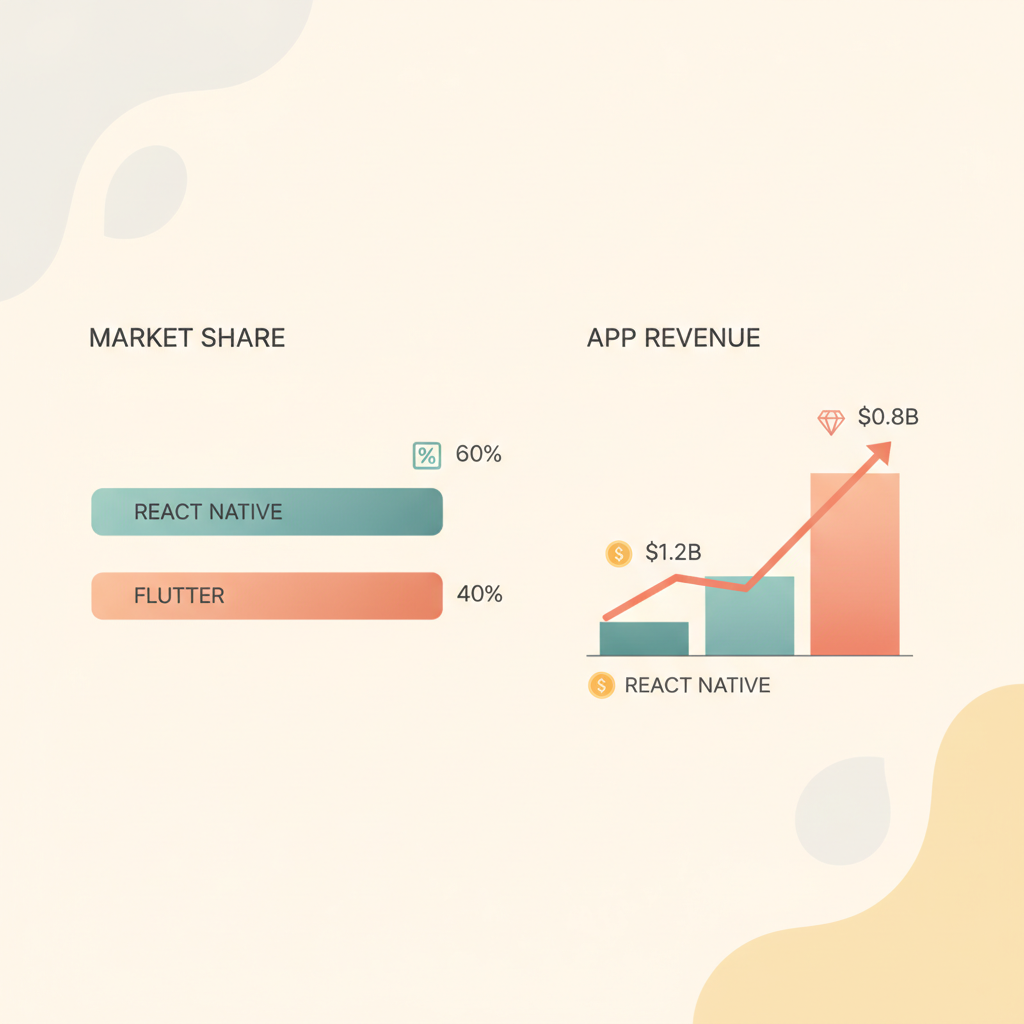 This popularity translates directly into market success. In 2026, estimated 30-day app revenue was nearly equal, reaching approximately $287 million for React Native and $283 million for Flutter [7]. This financial parity demonstrates that choosing either framework for an MVP does not limit a startup's long-term monetization potential or market success. Additionally, Appfigures SDK-detection data from late 2025 showed React Native was used in 1,350 of the top 10,000 non-game iOS apps, compared to 1,184 apps using Flutter [9]. While Flutter is highly popular for new releases, React Native maintains a slightly larger footprint among established, high-ranking non-game applications. ## Which Framework Offers Better Performance Benchmarks? In 2026, React Native's New Architecture (featuring Fabric, JSI, and TurboModules) has become the default, while Flutter's Impeller engine delivers 50% faster frame rasterization [2]. These architectural updates mean that historical performance gaps have largely closed, allowing both frameworks to deliver production-grade maturity for MVPs. However, key technical differences remain.
  Real-world benchmarks show that Flutter consistently launches faster, with startup times of 0.9 seconds on Android and 0.8 seconds on iOS, compared to React Native's 1.5 seconds on Android and 1.2 seconds on iOS [3]. Flutter achieves these faster cold start times because it compiles ahead-of-time (AOT) to native ARM machine code, whereas React Native relies on JavaScript bundle parsing and bridge initialization. However, on React Native's New Architecture, the managed framework Expo achieves cold start times of approximately 341 ms on Android and 267 ms on iOS, matching bare React Native performance [8]. This benchmark proves that using Expo for a React Native MVP no longer requires sacrificing startup speed for development convenience. For rendering performance, Flutter holds a slight edge in intensive scenarios. In list-scrolling performance tests of 1,000 dynamic cards, Flutter maintained a consistent 58 to 60 FPS, while React Native achieved 50 to 55 FPS on mid-range devices [4]. Flutter's custom rendering engine draws every pixel directly onto a canvas, which prevents UI lag during heavy scrolling or complex animations in an MVP. ## How Do Development Costs and Developer Availability Compare? Both Flutter and React Native reduce overall mobile app development costs by 30% to 60% compared to building separate native iOS and Android applications [5]. This cost efficiency makes cross-platform development the default choice for startups and SMBs looking to launch a mobile MVP quickly without doubling their budget. React Native developers are significantly more abundant, with approximately 3.4 times more available React Native developers than Flutter developers in regions like the UK [6]. Because React Native is written in JavaScript/TypeScript (which is known by 78% of working developers according to Stack Overflow) hiring and staffing a React Native MVP team is often faster and more cost-effective. Furthermore, a 2026 framework comparison indicates that using a technology your development team already knows cuts MVP delivery timelines by 40% to 60% [10]. This finding emphasizes that team expertise and developer familiarity are far more critical to a rapid MVP launch than minor technical differences between Flutter and React Native. ## Are There Rising Alternatives to Flutter and React Native? While Flutter and React Native remain the dominant cross-platform choices, Kotlin Multiplatform has emerged as a rising competitor, doubling its enterprise adoption from 12% to 23% over an 18-month period leading into 2026 [11]. Founders should note that Kotlin Multiplatform is increasingly favored by teams seeking native UI with shared business logic.
 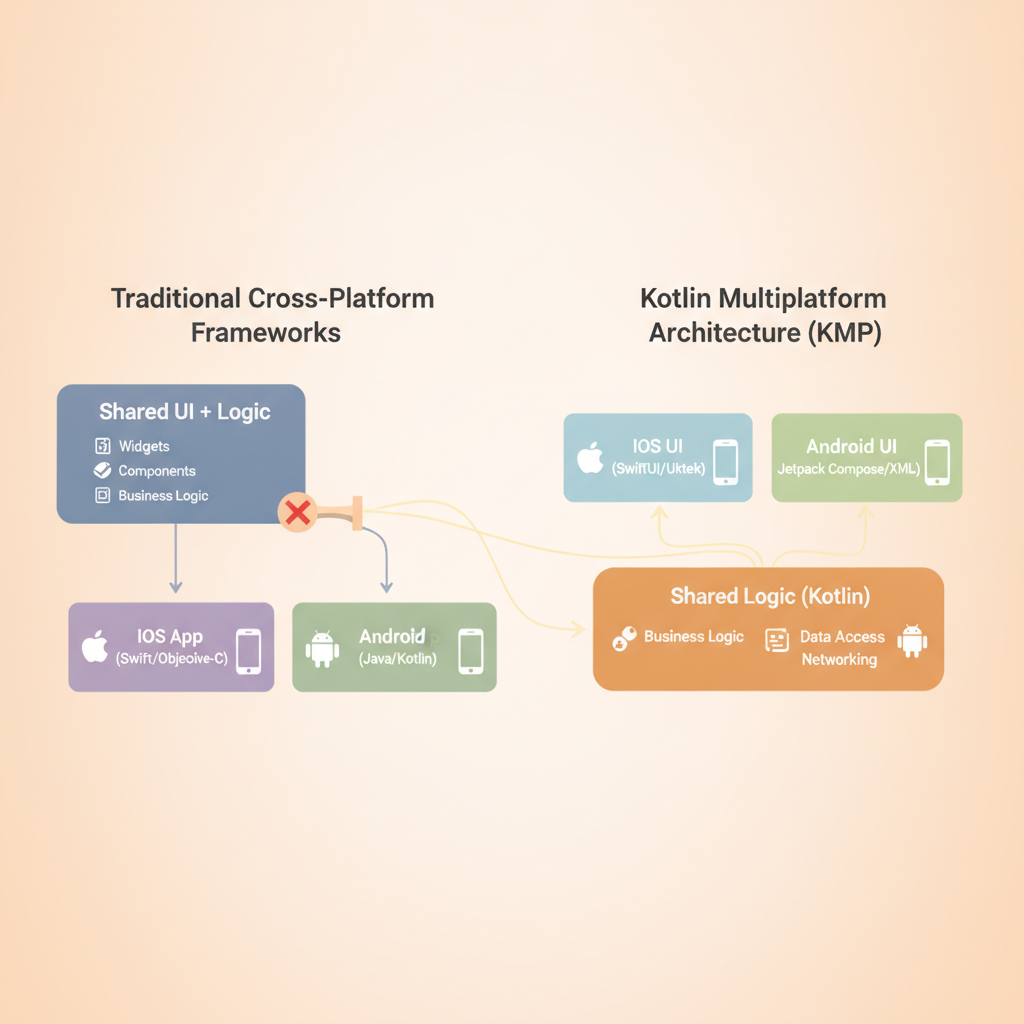 Choosing Kotlin Multiplatform can be highly beneficial if your product requires a completely native look and feel on both platforms while avoiding the need to write duplicate business logic. However, for most early-stage MVPs, Flutter and React Native still offer faster initial setups and broader library ecosystems. ## How to Choose the Right Framework for Your MVP To make the final decision for your mobile MVP, follow these strategic steps: * Step 1: Assess existing team skills. If your developers already know JavaScript or React, choose React Native to speed up development by 40% to 60%.
- Step 2: Analyze rendering requirements. If your MVP requires highly custom UI, complex animations, or 60 FPS rendering, choose Flutter.
- Step 3: Evaluate hiring needs. If you plan to scale your team rapidly in competitive markets like the UK, choose React Native for its 3.4 times larger developer pool.
- Step 4: Determine startup speed priority. If cold start performance is critical, choose Flutter for its 0.8s to 0.9s startup times, or use React Native with Expo's optimized architecture. Choosing between these tools is no longer a matter of choosing between high and low quality. Both options provide the performance, monetization potential, and stability required to scale from a simple MVP to a successful, revenue-generating product. Together, they dominate over 80% of the cross-platform market, making them the top choices for building an MVP. ### How much does cross-platform development reduce mobile app development costs?
Yes, Flutter consistently launches faster, with startup times of 0.9 seconds on Android and 0.8 seconds on iOS, compared to React Native's 1.5 seconds on Android and 1.2 seconds on iOS [3]. This difference is because Flutter compiles ahead-of-time to native machine code, while React Native parses JavaScript bundles. ### Can Expo match the performance of bare React Native?
Yes, on React Native's New Architecture, the managed framework Expo achieves impressive cold start times of approximately 341 milliseconds on Android and 267 milliseconds on iOS [8]. This performance matches bare React Native, meaning developers do not have to sacrifice speed for convenience. ### Which framework has a larger developer hiring pool?
React Native has a significantly larger hiring pool, with approximately 3.4 times more available developers than Flutter in regions like the UK [6]. This abundance exists because React Native uses JavaScript and TypeScript, languages known by 78% of working developers. ### Does choosing Flutter or React Native affect long-term app revenue?
No, choosing either framework does not limit your monetization potential. In 2026, estimated 30-day app revenue was nearly equal, reaching approximately $287 million for React Native and $283 million for Flutter [7]. ### What is a rising competitor to Flutter and React Native in 2026?
Kotlin Multiplatform has emerged as a strong competitor, doubling its enterprise adoption from 12% to 23% over an 18-month period leading into 2026 [11]. It is highly favored by development teams seeking native user interfaces paired with shared business logic. ## Sources
- discretelogix.com — https://vertexaisearch.cloud.google.com/grounding-api-redirect/AUZIYQHAS9RxPzDKq34cDS_YH4IwL0awHHhvUixgHgRk-SqegxS1bp--Avg1UfeIGwJyQJKmAr0l2fPdSuAcxkTL1kbr7DUprbnQO-OPHJ3N9q0KXlnQw5p4ca5q5ez6s31zo5RIUIUpji_G03c_Qx4=
- agilesoftlabs.com — https://vertexaisearch.cloud.google.com/grounding-api-redirect/AUZIYQHlkpxpSLI2MxOqz_bkHdR1bGr731YWvqjLUmgOfLRno6Pqx8qCnGkVfcfePySZVm0dZgiXh7t2n12U_VVcMTwxxvC8ysA1-Y8kOW_scWt4hkQNKhMyIWkQYtbOfIw3J5wPHtpAlBROKx-aGE-FuaJjMo6vmmsANV2tgHQ1rCM9kp1F3t_yE4d9
- medium.com — https://vertexaisearch.cloud.google.com/grounding-api-redirect/AUZIYQF9QUJRQSADF1DwXnAAlzW_GFwCXfnxvRUrPHOpGruZFFsrggRHbtk9gR-0YO4TOx3pwdLyDZjvlnY2fBOEoDW1c1vCt3RATMnPD5t-K55yGBTONPmCh2cgsMyLvuWmiL1UL2VtDtd-iBmEFDrIe8cDLRN8jClw181HzKKJeP8Ug0q794MDU589UsT0kuTzlCziGCBdijGK
- adevs.com — https://vertexaisearch.cloud.google.com/grounding-api-redirect/AUZIYQE0XGyc-RP2vH_aCVktdYzhnEtjROXUA3oMPhSqJmrDH-zD1HKtqRzD1mPskX6LbYQBNpn8hCcYCCtJ8l_eZWEuWVCJTj70Ug24LnNdFkXnD2duXmwLB_vk1fZfNRkBYMVFzyVuew==
- catdoes.com — https://vertexaisearch.cloud.google.com/grounding-api-redirect/AUZIYQGX_XJzxE-8GuAxwaChPVrzPgBQACSIN_rN-t7QhEJ5ExIjDG9aeqDWLZke-TisIl778q3r7Hia9wk1ny8PAL1mjF1HaTVPOqs9m9m3_c0UOD7NsFiRpJ0wZtZO4BHKomKv92R5AfLiND9dPw==
- foresightmobile.com — https://vertexaisearch.cloud.google.com/grounding-api-redirect/AUZIYQGo4LwRgDFWMabd6mHIgurSPi8n1sCRtQnQL_NvpihNPR2dkEPMmslbf5YpmbTcHbYrgg3Ju_X8CBxjnOvTcNEDDAa99J-iOJ4ik-fajUIIJolR41nK7tMZQT24UPhQonXVna7GX9jO0RFj2SXzrDf8ZJSM
- medium.com — https://vertexaisearch.cloud.google.com/grounding-api-redirect/AUZIYQHX4GkAeRcvWe_tPL5meY2ro0jmKHKrFgi8RsqxBZFERs2UqR9xLkWWCjv9gjKquZAYjQorPKtzEm6r2OB85lYyaLvjC3tBrcdU3Rgnpm0ZAIDU716jbS3TS9iCqCYjzEUmoApwXsuUwmD2EbSDhGEK0FER_RitXsxf0q6iskbdSJOTL7WptXrrFnaKbo9gGP05hqQ4i-0YtFrwrMU=
- quashbugs.com — https://vertexaisearch.cloud.google.com/grounding-api-redirect/AUZIYQHuIsM90bq9QKmKxFZRK8Auli_7oGohXr3O7RFkY1fzouogkL0SnHswMWhhv7-moBf9npI0qkWjFbOBPJNTAtjgNiPWORPez4O8FAwWK0JwbN-u1wMa7hzQmkzsdRhhcmANrIwKHv0ELE2eHQfQF3Y3JDhx
- applighter.com — https://vertexaisearch.cloud.google.com/grounding-api-redirect/AUZIYQHgQPzRJfSHS9ab7rJD1EOJSppayUpd6MSuKFkyGoLpXwY6IkHe9d5AgKN1It4VqUDN39HcFSFPFfSGWAsIxoouY_V_HMFgze71BLQZv8dK5HvpoyV7e-3QlU8cbxRhE6jtyX9qB6kOAxAMGo5ZwjDihuv10S2t4WmaXIF6dQY2WwGaMGJVgN0V_CWK4EXvzPYqhUjPdmGRZuDMkPUcuDMC
- devgenius.io — https://vertexaisearch.cloud.google.com/grounding-api-redirect/AUZIYQFLCVz5lsjq9qSFXnvmHb-J8Nm_m1807fMaYrnmb_bcezR-8hnMKjU1MfeEwaf3VvkXUuedIsVaAedZIcErhmaNgjpjOspz24TPpSp1xtUKRAuE7gXZVet4C1-w00Y-IdQ34OuVNZK-TR7JXqLJ4ngb58v2gws5S12mP0ipWc3PWA3grm-cdSDjxc-RKkx2WR_41UQM
David Friedman — Founder & Lead Engineer, AppBrewers · LinkedIn
David Friedman founded AppBrewers to turn agentic AI into shipped software. He builds the infrastructure that automates app creation and deployment, so products go from idea to production in weeks, not months. He is also the builder of Conversify, an AI communication platform for service businesses. Based in Malta, serving clients across Europe, the US, and the UK.