How to Budget and Scope a Multi-Tenant SaaS MVP in 2024
Learn how to accurately budget and scope a multi-tenant SaaS MVP. Discover cost breakdowns, architectural insights, and tips to avoid critical technical debt.
Published on September 22, 2026 · Updated on September 22, 2026
SaaS development cost estimation for a multi-tenant MVP typically ranges from $15,000 to $30,000 for a production-ready build [2], while a full custom SaaS MVP averages $45,000 to $91,000 [1]. A basic single-workflow MVP can cost as little as $5,000 to $15,000 [2], whereas a mid-scope B2B platform with multiple integrations can range from $90,000 to $250,000 [6]. Understanding these figures is critical for founders. Approximately 25.6% of SaaS startups shut down in 2024, with 70% of failed venture-backed startups running out of capital. This makes realistic planning essential. By factoring in year-one iteration, infrastructure, third-party fees, and compliance, the realistic first-year budget actually expands to a range of $70,000 to $220,000 before founder salaries and marketing [1]. ## What is the Real Cost of a Multi-Tenant SaaS MVP? The global SaaS market is projected to reach $315.68 billion in 2025 and grow to $1.13 trillion by 2032 [5]. Despite this massive expansion, 70% of new users abandon software within three months due to poor product planning and misaligned unit economics [5]. Accurate SaaS development cost estimation prevents these early failures. When planning your build, you need to understand the different pricing tiers:
- Basic Scoped MVP ($5,000 to $15,000): Features a single workflow and basic billing, taking 8 to 10 weeks to deliver [2].
- Production-Ready Multi-Tenant MVP ($15,000 to $30,000): Features team accounts, role-based access control, and metered billing, taking 10 to 12 weeks to build [2].
- Mid-Scope B2B SaaS Platform ($90,000 to $250,000): Features multi-tenancy, role-based access, and three to five integrations [6].
- Lean Custom Build ($19,000) to Complex Custom Platform ($190,000+): The full spectrum of custom software development [1].
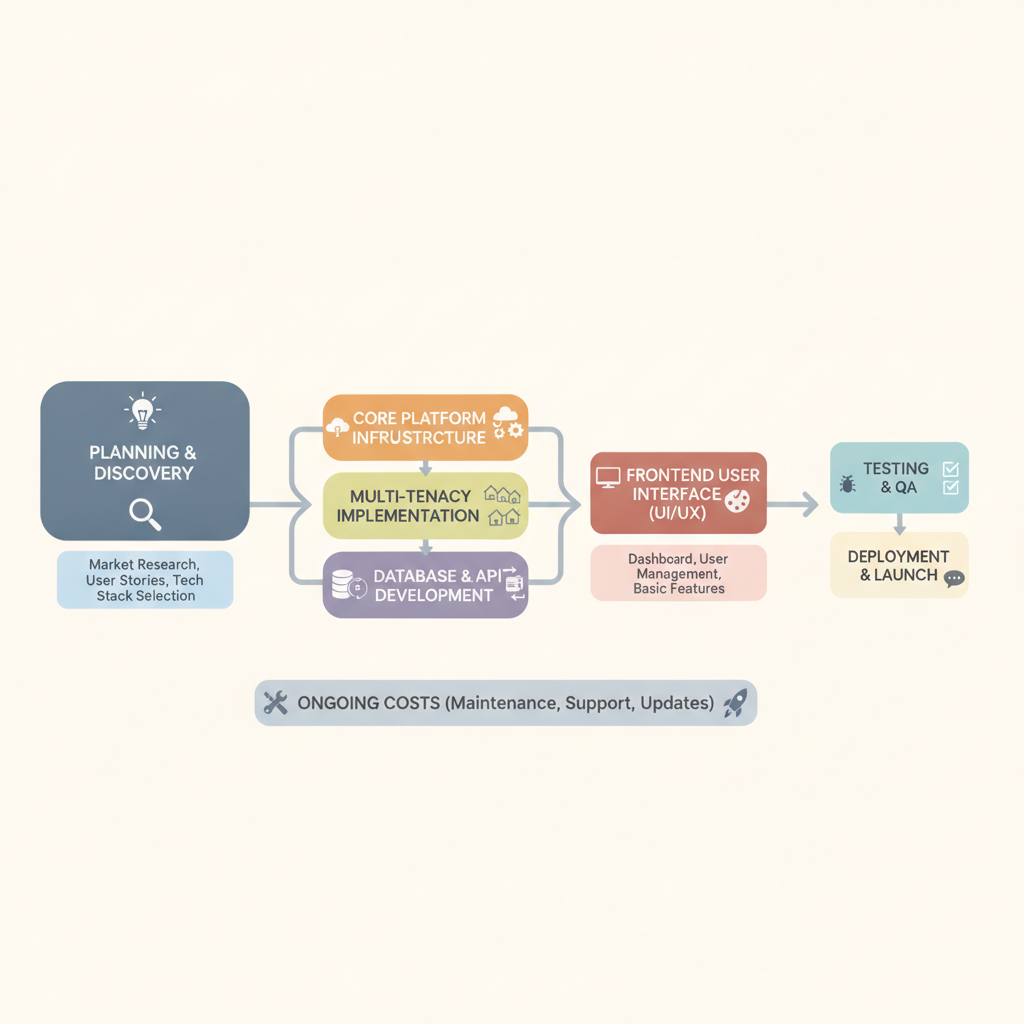 ## How to Allocate Your SaaS MVP Budget To ensure your project stays on track, it is essential to understand where every dollar goes. Backend engineering typically consumes the largest portion of a SaaS MVP budget at 35%, followed by frontend engineering at 25% [2]. Based on a typical 10-week, $18,000 SaaS MVP budget, the allocation breaks down as follows:
 - Backend Engineering (35%): Focuses on multi-tenant data modeling and billing webhooks [2].
- Frontend Engineering (25%): Focuses on user interface and client-side logic [2].
- Product Design (15%): Covers user experience and interface design [2].
- DevOps (10%): Covers deployment pipelines and cloud infrastructure [2].
- Quality Assurance (10%): Focuses on testing and bug resolution [2]. Additionally, the discovery and architecture phase of a SaaS build typically accounts for 5% to 10% of the total development budget [8]. Skipping this initial phase is one of the most expensive mistakes a founder can make, as a single week of proper discovery can prevent months of costly code rework [8].
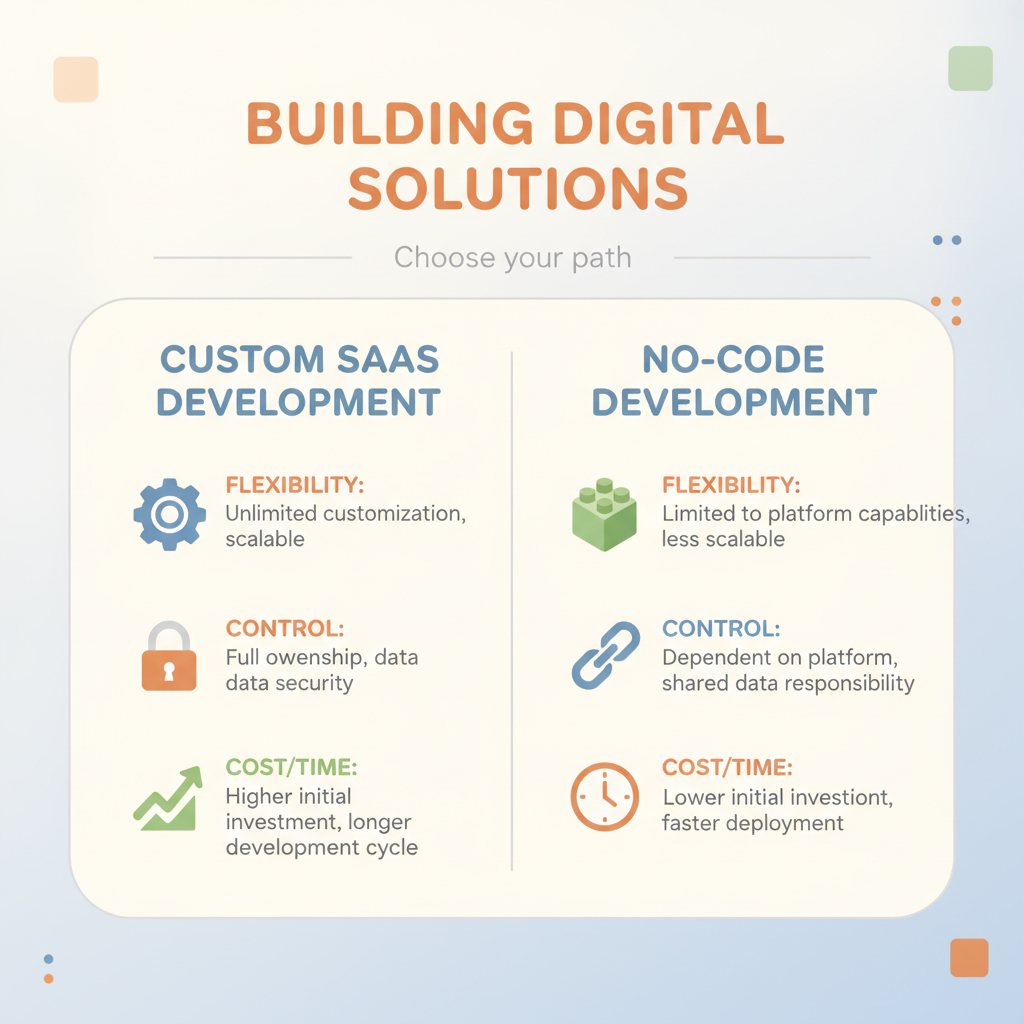
 ## Why Your Database Tenancy Model Can Make or Break Your Startup Choosing the wrong tenancy model at the MVP stage can cost 3 to 5 times more to refactor at scale [3]. Defining the correct multi-tenant database pattern upfront through professional consulting prevents the accumulation of critical technical debt that often halts SaaS growth [3]. However, implementing database-level multi-tenancy, such as database-per-tenant or schema-per-tenant models, can double infrastructure complexity and add 2 to 3 weeks to the initial development timeline [2]. Early-stage founders should default to a shared database with row-level security scoping unless strict compliance or data residency requirements mandate isolated databases [2]. Opting for the right setup pays off. Multi-tenant SaaS companies built on shared infrastructure deploy product updates 4 to 8 times faster than their single-tenant equivalents [4]. This dramatic difference in deployment speed provides startups with a compounding product velocity advantage when iterating on customer feedback [4]. Furthermore, transitioning from a single-tenant infrastructure to a multi-tenant architecture can reduce monthly hosting costs from $8,000 to $15,000 down to $3,000 to $7,000 for a SaaS business at $1 million ARR with 200 customers [4]. These annual infrastructure savings of $60,000 to $96,000 directly improve gross margins, which can significantly influence Series A valuation multiples [4]. ## Custom Development vs. No-Code Alternatives Gartner predicts that 70% of new applications will use low-code or no-code platforms to reduce development costs and accelerate delivery [7]. While low-code tools can lower the initial barrier to entry, custom builds remain necessary as application complexity, AI integrations, or compliance needs grow [7]. For founders seeking a robust, scalable, and secure platform, custom development is the safest long-term investment.
  ## Frequently Asked Questions ### What is the average SaaS development cost estimation for an MVP?
A production-ready multi-tenant SaaS MVP with team accounts and metered billing typically takes 10 to 12 weeks to build [2]. A basic scoped MVP with a single workflow can be delivered faster, usually taking 8 to 10 weeks [2]. ### Why is database tenancy choice critical for early-stage SaaS?
Choosing the wrong tenancy model at the MVP stage can cost 3 to 5 times more to refactor when scaling up [3]. While database-level isolation adds 2 to 3 weeks of development and doubles complexity, starting with a shared database with row-level security is often the best default [2]. ### How does multi-tenancy affect ongoing hosting costs?
Multi-tenant architecture on shared infrastructure can reduce monthly hosting costs from $8,000 to $15,000 down to $3,000 to $7,000 for a business at $1 million ARR [4]. This saves $60,000 to $96,000 annually, which directly improves gross margins and valuation multiples [4]. ### What percentage of the budget should go to discovery and architecture?
The discovery and architecture phase typically accounts for 5% to 10% of the total SaaS MVP development budget [8]. Spending a single week on proper discovery prevents months of costly code rework and ensures better planning [8]. ### Can I use low-code or no-code platforms for a SaaS MVP?
Yes, low-code platforms can lower the initial barrier to entry, and Gartner predicts 70% of new applications will use them [7]. However, custom builds remain necessary as your application complexity, compliance needs, or AI integrations grow [7]. ### Why do so many SaaS startups fail within the first year?
Approximately 25.6% of SaaS startups shut down in 2024, with 70% of failed venture-backed startups running out of capital. Additionally, 70% of new users abandon software within three months due to poor product planning and misaligned unit economics [5]. ## Sources
- milosolutions.com - https://vertexaisearch.cloud.google.com/grounding-api-redirect/AUZIYQFqDcEDEGbtEeuRERlIyIDJBElZYT8z3Ju-Z518pe7ATuohOOMzJ_9BV8Ys2qAmVXJs-aLYT1d3qihaTo0JFaFae7QyLXBzvOuweaHyfhOPTllRblCerQ65a2DrJpFSzd4TYBshj78afB5M8SQ=
- datasofttechnologies.com - https://vertexaisearch.cloud.google.com/grounding-api-redirect/AUZIYQEAeT82aL87bKBKTgj843qsN5HG3CBWKfnMM7ZaOjs6gcSvEj4hl0B8qk67DID0jEe5UA4PSYM246MQtHcWUwK8RZKSutF2gCXDXW9sOhNAeOyvjz6cwKwE7_0K4r8Ts5IFkl4OPXtuL6MiqXiO2SeHeA9I4A==
- bolderapps.com - https://vertexaisearch.cloud.google.com/grounding-api-redirect/AUZIYQHGzKRc8Nc89GeyRZEq3iHjDUk4k0HmCXhCoNy-NP0HImfJQ0_o8ao_V5aWPGjXb71gYCQ16J08aRQ6LmpbAn5iIugwdZecB8KITjsA7O7ibue-Vj4qVtv8BwtwfOeNGZXlhXaiynxsAZ480SIrs49kSLoIShFrr8Q6ybJVnedWLk_2lMJjUco-T363XTu0ZOTm7Sb25TTrjw==
- agamisoft.com - https://vertexaisearch.cloud.google.com/grounding-api-redirect/AUZIYQHAQUEsTGro6OAjQ1WOsWtWP30S0v3Ol6GvM6ENdyJQRL7xhfm6sQcphNZhXqO6mZT8KTg3-BilMVXh9rzdg1ZL9br5m_PSiNAG2OQx8EgywQxlECdQBhpA0LBOkrxuI6V7koPOOYrG72CkJT6G0ICrKJ7f-hSkKi7z
- eucalipse.com - https://vertexaisearch.cloud.google.com/grounding-api-redirect/AUZIYQEjnOlcg8NCn6--KalKqqP3cpMpxMOb9CwKL9IA0HKSg9Zfs_sk2cuaWUZjwP_cnevbCYQoCKxtpz0aPmA-YS1pEOON132ymdNTSogbdplAUiuYSi80KEegHBevoh_Jm1E4Li9GZEVSB5d7e1qoWui801Y_yqg=
- acme-one.com - https://vertexaisearch.cloud.google.com/grounding-api-redirect/AUZIYQHE7uSQSmM6Xu7CTxIKZcPVPE_2Ye5gzanf3OdcuqyJ3ATRTyMnkqyGjx9CklBzrIRrbtYAVcswzMMud_j62aXg9oduX4ZVH_SnaddllRXXpfJpHEw4qCG6fFNfEUvmTDF0z2fCPIMsfDXgvFuOlKag0-jxfck-vqQk-gQa1VAYhvJFQfQfKwkTp6lkG7mnGJ_Y1PuKi9izs22btE7AzG0rbCI=
- ideas2it.com - https://vertexaisearch.cloud.google.com/grounding-api-redirect/AUZIYQETl_XAJcK0so5739qmUVDykVGADsMkavhI2kjdVj1nfo9-aFDwwREKc8CBfc7ePZQk3UFSnl7niDcAppKTW4v1MeBmwCHtaEX0TD_nEP0ZjSzApGxwTqkHDEXPj1WVfpcVQg9jWZUaWc0=
- valueans.com - https://vertexaisearch.cloud.google.com/grounding-api-redirect/AUZIYQEDM6FK6utTAOb5E6dUolUvmsJ12qb9zOgG744Z5bzaoD7TufIq0n6RCZoM-4USDtEsSyBRT7EZpmmJPCFGYM-PI-tIHbtGBERiM1NKzo7nYV0M7mVAwUhJaVBskOT7gYfjnysfdw== Navigating the complex landscape of SaaS development cost estimation requires a strategic balance between budget, timeline, and architecture. By prioritizing a thorough discovery phase and choosing a cost-effective, scalable multi-tenant architecture, early-stage founders can protect their runway and build a highly responsive product. Whether you choose custom engineering to handle complex compliance and AI features or start with a leaner framework, partnering with an experienced development team ensures your platform is built to scale from day one.
David Friedman — Founder & Lead Engineer, AppBrewers · LinkedIn
David Friedman founded AppBrewers to turn agentic AI into shipped software. He builds the infrastructure that automates app creation and deployment, so products go from idea to production in weeks, not months. He is also the builder of Conversify, an AI communication platform for service businesses. Based in Malta, serving clients across Europe, the US, and the UK.