
Custom Web App vs No-Code: Which Should You Build?
Deciding between a custom web app and a no-code platform comes down to IP ownership, scaling costs, and speed. Learn how AI-accelerated development bridges the gap between speed and custom code.
Published on October 22, 2026 · Updated on October 22, 2026
Choosing between a custom web app vs no-code depends on your growth speed, budget, and ownership requirements. No-code tools let non-technical founders launch simple tools in days or weeks, cutting initial costs by up to 70% [10]. However, custom web app development provides full source code ownership, scalable infrastructure, and unrestricted API integrations. Gartner predicts that 70% of new applications will use low-code or no-code technologies by 2026 [18]. Yet, nearly 50% of enterprise adopters face performance limits as business logic scales [10]. Meanwhile, modern AI-accelerated custom development allows engineering teams to complete tasks 55% faster [15], delivering production-ready bespoke software in weeks rather than traditional multi-month timelines. If you need to validate a concept quickly with low upfront costs, no-code is an ideal start. But if long-term scalable architecture, proprietary software IP, and predictable hosting fees matter, building an AI-assisted custom web application with a partner like About AppBrewers is the superior strategic choice.  ## What Is the Difference Between Custom Web Apps and No-Code Platforms? No-code platforms provide visual drag and drop interfaces that allow non-technical builders to configure databases, user interfaces, and business logic without typing syntax. Custom web app development involves writing tailor-made code using full-stack frameworks like React, Node.js, or Python, usually hosted on scalable cloud infrastructure. The global market for low-code and no-code technologies is expanding rapidly. Gartner forecasts the worldwide market will reach $58.2 billion by 2029, growing at a 14.1% compound annual growth rate [18]. Demand is driven by persistent global shortages of technical talent and corporate demand for automated processes [18]. Gartner also estimates that by 2026, 80% of low-code platform users will originate from outside central IT departments, up from 60% in 2021 [18]. However, the distinction between visual builders and professional engineering is evolving. Forrester research reports that 87% of enterprise software developers use low-code development platforms for at least a portion of their software creation work [11]. Rather than replacing developers, visual platforms are often combined with bespoke code to eliminate repetitive setup tasks. ## No-Code Development: Speed and Cost Savings for Early Validation For early-stage startups and non-technical founders, no-code builders offer an immediate path to market validation. Building a minimum viable product (MVP) on visual platforms takes days to weeks, compared to 3 to 12 months for traditional custom engineering [12], [14]. Key benefits of visual platforms include: - Lower initial capital expenditure: Industry survey data indicates no-code tools can reduce initial development costs by up to 70% [10].
- Faster feedback cycles: Founders can modify workflows and interfaces in real time without waiting for software deployment pipelines.
- Non-technical management: Business teams can maintain internal tools without relying on internal IT resources. When testing demand or building simple tools, visual platforms excel. You can review related articles on rapid MVP validation to learn more about structuring your launch strategy.
 ## The Hidden Risks of No-Code: Lock-In, Performance, and Scaling Costs While visual app builders offer speed upfront, growing businesses often encounter significant friction as user concurrency increases. ### 1. Proprietary Vendor Lock-In and IP Risk
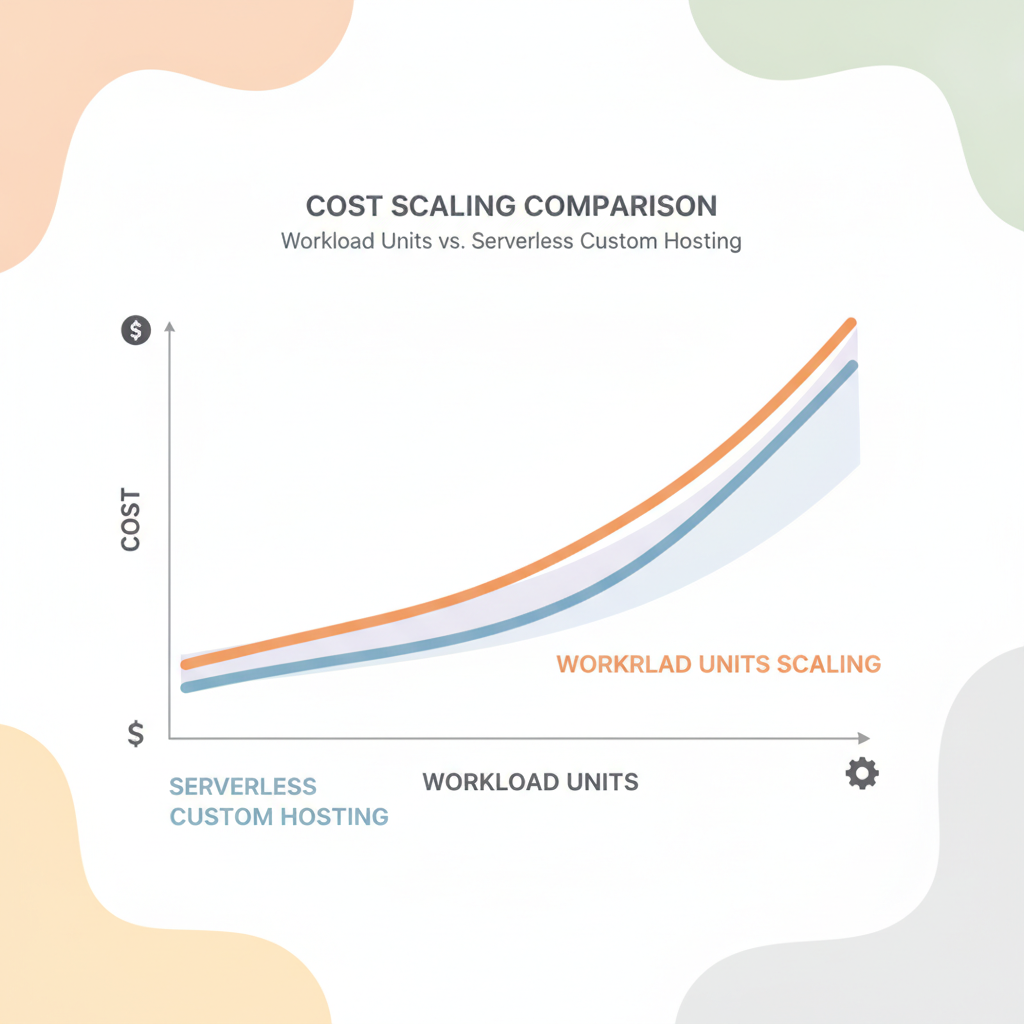
Visual platforms such as Bubble calculate hosting fees using usage-based metrics like Workload Units [9]. Monthly operational overhead scales unpredictably as database queries, API calls, and active user concurrency increase [9]. In contrast, custom web applications hosted on serverless or cloud infrastructure offer predictable, cost-effective scaling at high traffic volumes. ### 3. Architectural and Performance Bottlenecks
Nearly 50% of enterprise adopters encounter performance and integration limitations as business logic grows complex [10]. Custom integrations, specialized security standards, and deep database optimizations are difficult or impossible to execute inside restricted visual runtimes.
 ## How AI Development Accelerates Custom Web App Creation The traditional trade-off between visual speed and custom code flexibility is changing due to artificial intelligence. AI-accelerated full-stack development significantly reduces the time-to-market advantage traditionally held by visual no-code app builders. GitHub research demonstrates that software developers using AI coding tools like GitHub Copilot complete programming tasks 55% faster than developers working without AI assistance [15]. Furthermore, GitHub metrics reveal that AI coding assistants generate an average of 46% of all code written by active users, reaching up to 61% in boilerplate-heavy languages like Java [15]. By leveraging agentic AI workflows, modern development agencies deliver bespoke web applications in weeks rather than traditional multi-month timelines [15]. This approach provides the best of both worlds: fast delivery alongside complete source code ownership, enterprise security, and unconstrained scalability. If you want to check your project scope, you can get a quote for AI-accelerated custom development. ## How to Choose: Decision Framework for Founders and Enterprises To decide whether to build a custom web app or use no-code, follow these evaluation steps: - Define your intellectual property requirements: If proprietary algorithms or downloadable source code are essential for company valuation, select custom web app development.
- Assess workflow complexity: If your application requires complex background processing, custom database indexing, or complex third-party API integrations, choose custom code.
- Evaluate security and compliance: For healthcare, fintech, or enterprise apps requiring strict data privacy controls, opt for full custom engineering. ## Frequently Asked Questions ### When should I choose no-code over custom code?
No, leading visual platforms like Bubble do not support source code export, locking your application into their visual runtime. If you leave the platform, you must rebuild your software application architecture from scratch. Platforms that rent infrastructure prevent founders from holding software source code on their balance sheets. ### How much faster is custom web app development with AI tools?
Developers utilizing AI coding assistants complete programming tasks 55% faster than those working without AI support. On average, AI assistants generate 46% of active code, enabling modern engineering teams to deliver custom applications in weeks rather than months. ### What are the hidden operational costs of visual no-code builders?
Visual platforms often charge based on usage metrics like Workload Units, which scale unpredictably as database queries and traffic increase. Custom web applications hosted on serverless cloud infrastructure provide far more predictable monthly costs at high user volumes. ### Do enterprise engineering teams use low-code or no-code platforms?
Yes, research indicates that 87% of enterprise developers use low-code platforms for portions of their application creation work. Professional engineering teams combine visual tools for rapid boilerplate development with custom code to maintain scalability and enterprise security. ## Sources [1] Caspio Low Code Solutions: https://www.caspio.com/
- Build Orbit Studio Insights: https://buildorbit.studio/
- WeWeb No Code Architecture: https://www.weweb.io/
- Caster Consulting Analysis: https://casterconsulting.hu/
- Forrester Developer Research: https://www.forrester.com/
- Appinventiv Engineering Benchmarks: https://appinventiv.com/
- DBB Software Benchmarks: https://dbbsoftware.com/
- GitHub Copilot Productivity Report: https://github.blog/2022-09-07-research-quantifying-github-copilots-impact-on-developer-productivity-and-happiness/
- Gartner Forecasts and Press Releases: https://www.gartner.com/en/newsroom/press-releases/2022-12-13-gartner-forecasts-worldwide-low-code-development-technologies-market-to-grow-20-percent-in-2023 Choosing between visual app tools and custom code is no longer an all-or-nothing trade-off. By pairing full-stack custom engineering with modern AI acceleration, team teams launch dedicated, highly scalable web applications in weeks without sacrificing code ownership or performance.
David Friedman — Founder & Lead Engineer, AppBrewers · LinkedIn
David Friedman founded AppBrewers to turn agentic AI into shipped software. He builds the infrastructure that automates app creation and deployment, so products go from idea to production in weeks, not months. He is also the builder of Conversify, an AI communication platform for service businesses. Based in Malta, serving clients across Europe, the US, and the UK.