Custom Web App vs No-Code: How to Choose in 2026
Deciding between a custom web app and no-code is a pivotal decision for founders. This guide breaks down the costs, performance limits, and AI-driven timeline shifts to help you choose.
Published on September 21, 2026 · Updated on September 21, 2026
Choosing between a custom web app vs no-code depends on your long-term budget, scaling needs, and timeline. No-code platforms are ideal for launching standard MVPs and internal workflows quickly, while custom web applications are superior for complex, data-heavy, or proprietary systems that require complete IP ownership. To put this in perspective, by 2026, Gartner predicts that 70% of new applications developed by organizations will use low-code or no-code technologies, up from less than 25% in 2020 [4]. At the same time, AI-assisted development has reduced custom software creation times by 30% to 50% [5]. This shift makes a custom-built minimum viable product (MVP) highly competitive, often costing around $6,000 upfront with zero recurring platform fees [6], [7]. For businesses evaluating this crucial decision, consulting with an experienced agency like About AppBrewers can help clarify the best technical path. ## What Is a Custom Web App vs No-Code Development? Understanding the fundamental differences between these two approaches is essential for any modern business. Custom web application development involves writing tailored code from scratch using frameworks like React, Node.js, or Python. This approach provides absolute freedom over design, functionality, and hosting infrastructure. In contrast, no-code development relies on visual drag-and-drop builders and pre-built components. This movement is growing rapidly; Gartner forecasts that the global low-code development technologies market will exceed $30 billion in 2026 [1], [2]. This expansion is heavily driven by companies seeking to address a global software developer shortfall projected to reach 4 million unfilled positions [1], [2]. By 2026, Gartner also predicts that 80% of technology products and services will be built by people who are not professional software developers [3]. This citizen developer movement allows non-technical business users to ship applications quickly. However, while visual editors are excellent for simple interfaces, they operate within strict platform boundaries. 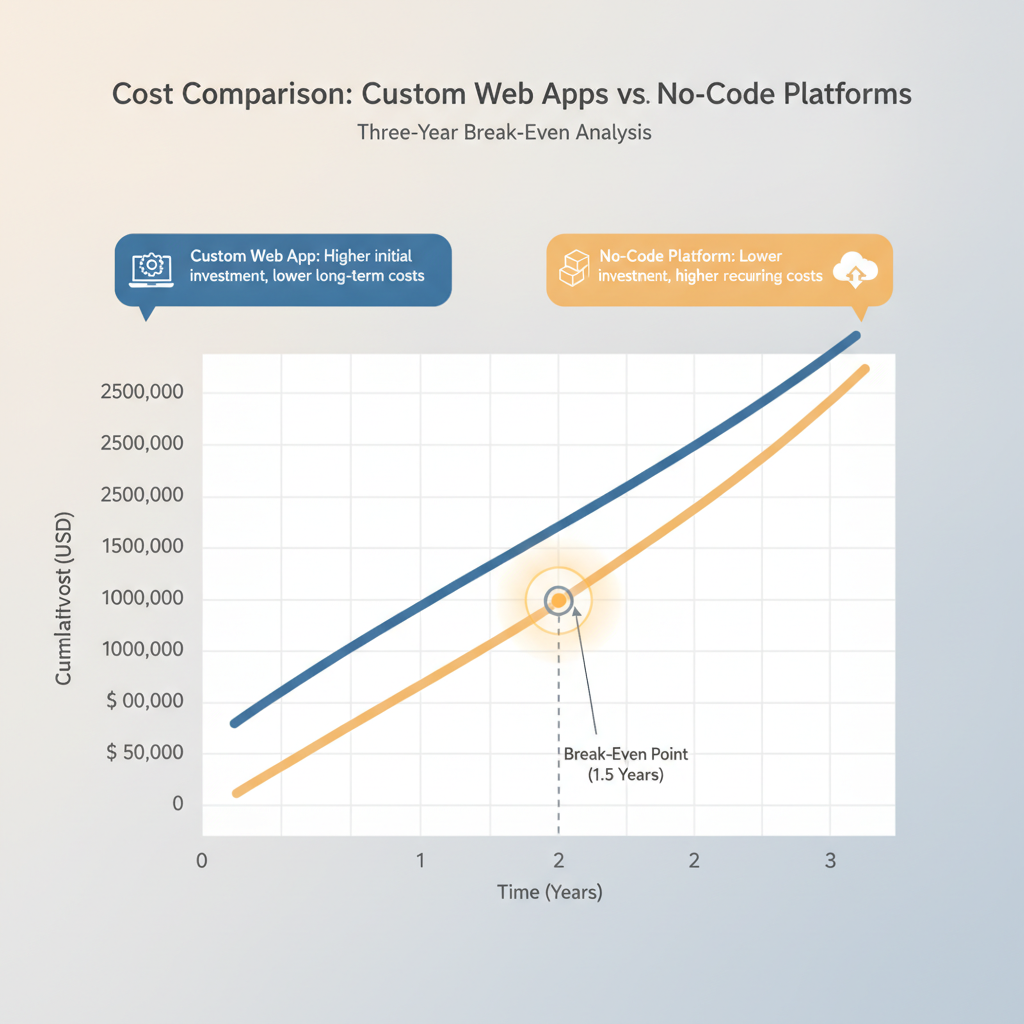 ## The Financial Breakdown: Upfront Costs vs Long-Term ROI When comparing the financial impact of a custom web app vs no-code, you must look beyond the initial setup costs. No-code platforms like Bubble or Webflow offer low entry points, typically ranging from $20 to $200 per month [6], [7]. For standard workflows and internal tools, organizations adopting no-code platforms report an average annual savings of $187,000 with a payback period of just 6 to 12 months [3]. However, the math changes significantly as your application grows. A basic custom MVP built with modern, AI-accelerated development tools costs approximately $6,000 upfront with no recurring platform subscription fees [6], [7]. While no-code is cheaper on day one, custom development becomes more cost-effective over a break-even period of approximately 2.5 years due to the compounding costs of premium no-code hosting, database scaling, and user seat licenses [7]. If you want to estimate your specific project budget, you can get a quote to compare custom development costs directly. ## Scalability and Performance: When Does No-Code Break? No-code platforms are highly efficient for prototyping, but they often hit performance bottlenecks when handling intensive data processing, large batch operations, or complex calculations [9], [12]. For example, popular platforms like Bubble can struggle with heavy backend logic, forcing growing startups to migrate their logic to dedicated backend providers like Supabase or Xano, or rewrite their applications entirely in custom code [10], [11], [13]. This migration process introduces severe balance-sheet risks. According to Gartner, 83% of enterprise data migration projects fail or overrun their budgets [8]. Vendor lock-in on proprietary no-code platforms is a major driver of these failures, as many visual builders do not allow users to easily export their underlying code or self-host their databases.
  ## The AI Revolution: How AI-Assisted Development Changes the Equation The rise of AI-assisted custom development tools like GitHub Copilot, Claude, and Cursor has completely disrupted the traditional build versus buy debate. These intelligent tools have reduced custom software development times by 30% to 50% [5]. This massive productivity boost has significantly narrowed the cost and timeline gap between building a custom web application and using a heavily customized no-code platform. At the same time, AI is also transforming mobile-first development. Building native mobile applications traditionally costs between $100,000 and $500,000 [14], [15]. Today, AI-powered no-code app builders like Adalo can generate mobile-first apps for a fraction of that cost [14], [15]. These platforms compile directly to native code and publish to the Apple App Store and Google Play Store, bypassing the web-only limitations of standard visual builders [14], [15]. For modern founders, this means the decision is no longer binary. You can explore our related articles to see how hybrid development strategies leverage both AI automation and custom code to build highly scalable SaaS products in record time. ## How to Choose: A Step-by-Step Decision Framework To determine whether a custom web app or a no-code platform is the right choice for your project, follow this structured evaluation process: - Assess your core functionality: If your application requires proprietary algorithms, complex data processing, or deep hardware integration, choose custom development. If you are building standard CRUD (Create, Read, Update, Delete) forms, simple directories, or internal dashboards, no-code is highly suitable. If vendor lock-in is a concern, custom development avoids the high risk of future migration failures.
- Analyze your timeline and talent: If you face immediate developer shortages, leveraging citizen developers and visual builders can bypass IT backlogs. If you need a robust, permanent product, partner with an agency utilizing AI-accelerated custom development.
 ## Frequently Asked Questions ### Is custom web development always more expensive than no-code? No, custom web development is not always more expensive in the long run. While no-code platforms have low monthly entry fees of $20 to $200, a basic custom MVP built with modern AI-assisted tools costs around $6,000 upfront with no recurring platform fees [6], [7]. Over a break-even period of approximately 2.5 years, custom development becomes the more cost-effective option [7]. ### What are the main performance limitations of no-code platforms? No-code platforms frequently face performance bottlenecks when handling intensive data processing, large batch operations, or complex calculations [9], [12]. These backend limitations often force scaling startups to migrate their database logic to external providers like Supabase or rewrite their applications entirely in custom code [10], [11], [13]. ### Can I export my code from a no-code platform if I want to migrate? Most proprietary no-code platforms do not allow you to easily export your underlying source code or self-host your application. This lack of portability creates a high risk of vendor lock-in. Because of these constraints, Gartner reports that 83% of enterprise data migration projects fail or overrun their budgets [8]. ### How has AI changed the speed of custom software development? AI-assisted custom development tools like GitHub Copilot, Claude, and Cursor have reduced custom software development times by 30% to 50% [5]. This productivity boost has significantly narrowed the cost and timeline gap, making custom-built web applications highly competitive with heavily customized no-code alternatives. ### When is no-code the best choice for an organization? No-code is the best choice for standard workflows, internal operational tools, and rapid MVP prototyping. Organizations adopting no-code platforms for these use cases report an average annual savings of $187,000 with a rapid payback period of 6 to 12 months [3]. It is also highly strategic for addressing the global shortage of 4 million software developers by empowering non-technical citizen developers [1], [2], [3]. ### How much does it cost to build a native mobile app using no-code versus custom code? Building native mobile applications traditionally costs between $100,000 and $500,000 using custom code [14], [15]. In contrast, AI-powered no-code app builders like Adalo can generate mobile-first apps for a fraction of that cost, compiling directly to native code and publishing to major app stores [14], [15]. ## Sources - [1] integrate.io: https://vertexaisearch.cloud.google.com/grounding-api-redirect/AUZIYQEzH-Q2L26tcpvQhEEdikvv23RaX1Hew8ONM7T4Utdsiso1DmiDkf9I3e09_HXLanMdpUOmtkq6o84ob0hl8Y-3V3QyopOysZ5ZiS1V4qTThFUn2ukcvJ38oN3kiAYNaxxllQZJD9Fhymm53fnXsG5knARqHcU4p6s=
 - [2] integrate.io: https://vertexaisearch.cloud.google.com/grounding-api-redirect/AUZIYQEzH-Q2L26tcpvQhEEdikvv23RaX1Hew8ONM7T4Utdsiso1DmiDkf9I3e09_HXLanMdpUOmtkq6o84ob0hl8Y-3V3QyopOysZ5ZiS1V4qTThFUn2ukcvJ38oN3kiAYNaxxllQZJD9Fhymm53fnXsG5knARqHcU4p6s=
- [3] kissflow.com: https://vertexaisearch.cloud.google.com/grounding-api-redirect/AUZIYQHGMmWw0cTR7iSJ_j6Jx0ohKgXAMi35XfH0U3tPXNhlWB1-ToMD-hLdUcuuHTJVeZytWzafWHSez6JZJeI_qp5Qo0ZNCqO2eqJxCxlKmR9JCMH84T5zBhMbTdGHR6U1IYE364D6DvyiIET4
- [4] ninox.com: https://vertexaisearch.cloud.google.com/grounding-api-redirect/AUZIYQGxbI71y1WnCgcrVYhfRxCgc08FmXF28lSksCEFNKPwP8JW2V5GmJ5HnexDwFfPf67WUb6lUE9MSt9Cxdkkin7TNy2FP06M-YWQcN2sJfZr7V7hhF7gYet1mHe0A6TtvviPnB0bBheisOA4ZrsqV3jzVHKMRrgpumDttRxxCrKL9ZMUOhF0yYm2sUXEqgAbH7UojQ==
- [5] searchlab.nl: https://vertexaisearch.cloud.google.com/grounding-api-redirect/AUZIYQHdg9o1y9-n-6L_Y52VQevLin7iuM0wTZ1LxMrA5prTpxep73C3Dllc4dHWqzhnhI9e4_SwFoqc0n8sHqTiBBECrr6eIASWudwUnKhuE1T8UuoC1gsCfSy0a63zAWe1gT6T7UFICP5-ivdLU5N9wJTDq7EuQON2_9w=
- [6] appbuilder.dev: https://vertexaisearch.cloud.google.com/grounding-api-redirect/AUZIYQFqisv9oamk706i2HJa3f6NQZ8RNtNoM7uHZomi1Or1ZBZXvt_3VvMyOjs4nhdNVvhSZG1CEQXizUSFiQlx-rJzRp1sYq5c9DKRS8O2otv1xsTxWBizL1Hqn7lr_K3VLv8uu8t0h_zoDvx1dRj1YUj_UDy7j4pfjL3_
- [7] appcost.ai: https://vertexaisearch.cloud.google.com/grounding-api-redirect/AUZIYQGcQt4fCpTvVGdXcA0sZLctvNsW8vdcwbCVuPK6IsXW_0q6AU4ExUFo0ISTOKkYycCT26Qz2xh5qluzjyVlZ6kmBta7adwzLXImTzjVPvBAcFGpd9vluq4Lamp2ybrEaFORNG9AeAkHlDxnknkNb1O6j0naThUGge7PcHBJ5ma0kbspPrO6Sm9xtaSXUhJ_-mZQPTBerg==
- [8] digisoftsolution.com: https://vertexaisearch.cloud.google.com/grounding-api-redirect/AUZIYQH8doBzF7snI3KXz_e8RS_FgoqD9ZXf4qPALUOPJEuZM76Ej4g1h-_aZCfGGx5bHfkyT8pyTGEZAjqgM0KHWqmj47yHR4zs44m_nNbidAFxJilFwORovsG4PVFhKUDWrTJRyYOzrKPrVFIn6jJ9m1WqoxoxdBFcDKAN
- [9] paloozalabs.com: https://vertexaisearch.cloud.google.com/grounding-api-redirect/AUZIYQE4wfevX3ogZ6CfXkG4mQJW4RW150fIbd07mTcS5icjx0CdhvLGhywoCQzDMeegRgSLEFsUP3ysuWSVo9C3JoQ8tHh6Awa9l_giE-TGiUHsC-fjkCizp506rS-talOLyY8qLtHCZIHPbctTihkRag==
- [10] lowcode.agency: https://vertexaisearch.cloud.google.com/grounding-api-redirect/AUZIYQG4Nkq1wYpaC3glSMri-FXgHI0yH6FWkCAd_6KySoOQ7g_luYus5BV-flyq-uJ1j-YCZJkSf_XFGts9mGSRT8_xXUX2oUzfGn6mkvL25fDalT05D_77D9Mrf1iyMXxHSLqIkNmv4Q0LCLO_bLIBZPwwYSZdyNuFPzeEQxY=
- [11] reddit.com: https://vertexaisearch.cloud.google.com/grounding-api-redirect/AUZIYQEhNe5HA-DslNIY8CtX6U-qR7uX0B6Pn2UBgnKoL6XtZZD-mH5Zzbxz0MWSdeOkqhwV7QXB0f1P41T8sDgHoAusBkdXAc1ZMVFNRJEcCygG7UOtt58QvAEVdVL4s0pJKUp-mUr6g9tsKHW5oy144Q6P9d4AiWhqBrcfjTdpm-zvTGZEdA==
- [12] bubble.io: https://vertexaisearch.cloud.google.com/grounding-api-redirect/AUZIYQF3UVr2gZsIQkAQhKgKX8YBcLd1Xxg9TwfwaLKfATiw2iArIqURvpgEJlsyghHiRjtY1obConDApxoRWzBZJ9D-boDPW3zKg7QXrhukrziOFBxsRx6JgK3foSWTnI3OTblpNRqBP8A3ui8pkpi0iTdK-b-cXnz-t9Gd-TibY_qwXa69oOa1eHMS
- [13] paloozalabs.com: https://vertexaisearch.cloud.google.com/grounding-api-redirect/AUZIYQEIb6VkMPustg8jghz3sfMmHQtqNBhVx4LwuxY3RCqOtHsrr_JnDAXVbdw7CJ-PrGtP5DXnQ_VUNj683v1FXYJSK3d4KT5ZuAZAv0BaJ52fxxkvj7zUlPAjLMDamLlMWQGelLCE1wp0gfc02_Q9JOPB21v-MEg=
- [14] adalo.com: https://vertexaisearch.cloud.google.com/grounding-api-redirect/AUZIYQHLTABusVHCh-AZUfT6eJSTi-0B0OooiwFGod4mckCnsgzcC7T4m8vKY2sFtSh7m-WZqstTpuMPeSDm_zktZ0nwFKOkP6b-UAj0z5c2qZyVWHmyrRxnN3ez--STNkYPUgyYUUtx4-TBcpuclT6WKib5I2zf-8nTeA3iZafY8q8dlMZZUp5LJzWaEide0XE9IMRM-oCS_LT-wLvUj0DYgxw=
- [15] adalo.com: https://vertexaisearch.cloud.google.com/grounding-api-redirect/AUZIYQG2jQZ4S8oWu1tVHB5277UzdUx2VtPPhGCxSP_yITyhkloH8TiEd5D2HENjGZTbMT00ruutm8fAvjHMo1u9M0o9iaznACOQyF43rJHZy8t_bi-mnZbRkRQFnHswW8GurLY= Selecting the right development path requires aligning your technical goals with your budget and scaling expectations. While no-code platforms offer rapid prototyping and cost savings for standard applications, custom web app development provides the performance, data security, and long-term cost-efficiency needed for complex products. By leveraging modern AI-assisted workflows, you can now build proprietary custom applications faster than ever, minimizing upfront investment while securing full code ownership.
David Friedman — Founder & Lead Engineer, AppBrewers · LinkedIn
David Friedman founded AppBrewers to turn agentic AI into shipped software. He builds the infrastructure that automates app creation and deployment, so products go from idea to production in weeks, not months. He is also the builder of Conversify, an AI communication platform for service businesses. Based in Malta, serving clients across Europe, the US, and the UK.