Custom Web App Development vs No Code: Why Apps Fail to Scale
No-code web apps fail to scale due to rigid platform limitations, escalating usage-based fees, and severe security vulnerabilities. Discover when to transition your startup or SMB to custom web app development.
Published on September 23, 2026 · Updated on September 23, 2026
No-code web apps fail to scale because of rigid platform limitations, escalating usage-based fees, and severe security vulnerabilities. While visual builders allow rapid prototyping, businesses often hit a strict capability wall, finding they can only build 60% to 70% of their desired features without needing expensive custom code or complex workarounds [2]. Furthermore, technical constraints on shared hosting environments can cause no-code projects to outgrow their infrastructure at as few as 100 active users [10]. As user traffic increases, database queries and API calls trigger compounding platform subscription costs and workload overages. In contrast, custom web app development offers a clear path to long-term scalability. If you are evaluating your options, you can get a quote to compare custom development costs directly with your projected no-code expenses. While no-code platforms offer a cheap entry point of $20 to $200 per month, the compounding cost of subscriptions and integration fees makes a custom-built MVP, averaging $6,000 upfront with zero recurring platform fees, break even in approximately 2.5 years [7]. ## The No-Code Capability Wall: Why 70% is the Limit Gartner reports that 70% of new business applications are expected to be built using no-code or low-code technologies by 2026, up from less than 25% in 2020 [6]. While this rapid mainstream adoption proves the utility of no-code for rapid prototyping and internal tools, it also accelerates the rate at which scaling businesses hit platform-specific performance and pricing bottlenecks [6]. Most users of advanced no-code platforms like Bubble or Webflow discover they can only build about 60% to 70% of their desired application features without needing custom code, APIs, or complex workarounds [2]. This capability wall forces growing startups to eventually hire developers to write custom code anyway, negating the initial no-code value proposition [2]. 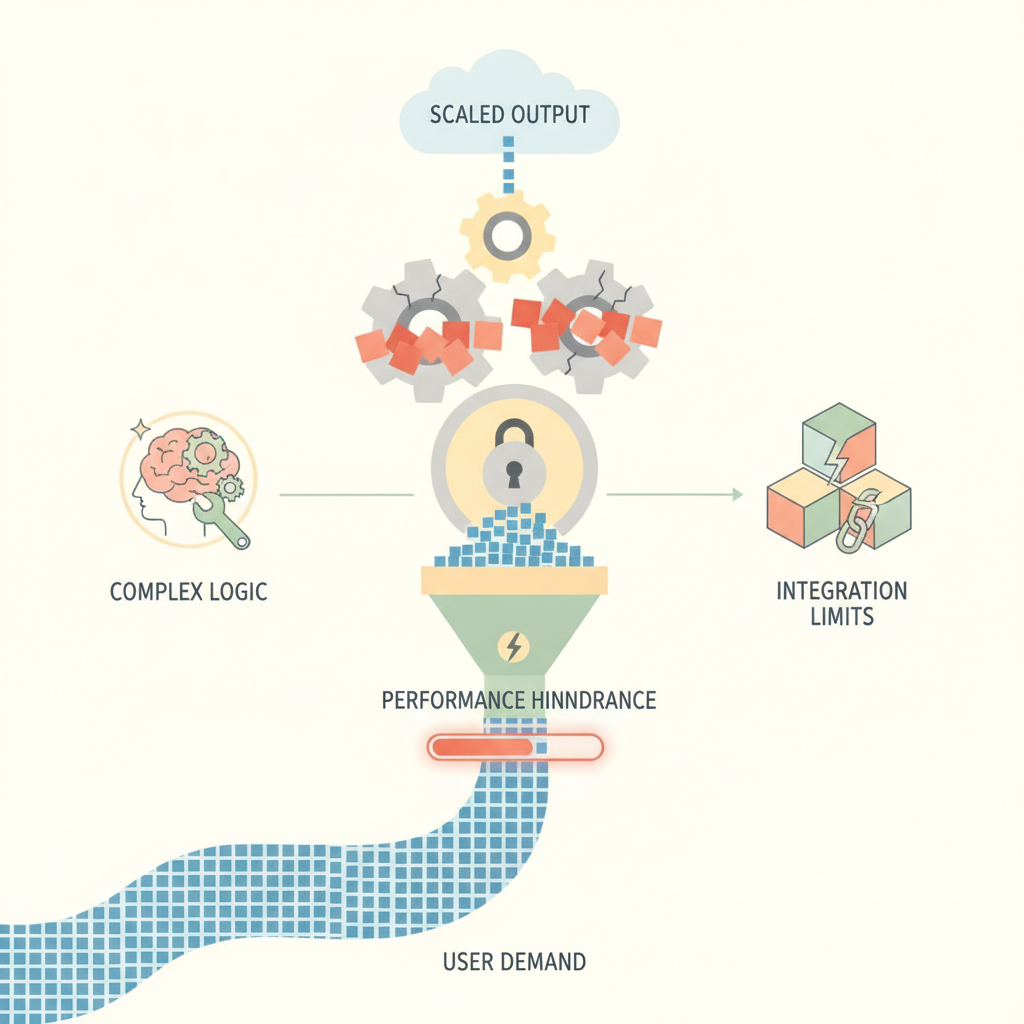 ## The Hidden Costs of Scaling: Workload Units and Hosting Bottlenecks Many teams do not realize that technical constraints on no-code platforms can cause some projects to outgrow their infrastructure at as few as 100 active users [10]. Unlike custom-built frameworks that can be optimized for specific workloads, no-code applications are bound to the generic, shared hosting environments of their parent platforms, leading to severe performance degradation as traffic scales [10]. Additionally, Bubble's usage-based pricing model measures server resources using Workload Units (WUs), where a Starter plan includes 175,000 WUs per month and a Team plan includes 500,000 WUs per month [1]. As no-code apps scale, database queries, workflow executions, and API calls consume these units rapidly, often forcing businesses into expensive overage tiers or custom enterprise pricing [1]. When comparing custom web app development vs no code, the long-term economics favor custom builds. Although no-code platforms offer a cheap entry point of $20 to $200 per month, the compounding cost of platform subscriptions, workload overages, and integration fees makes custom development more cost-effective in the long run [7]. ## The Security Risk of "Vibe Coding" and AI-Generated Code Many founders attempt to bridge the no-code gap by using AI code generators, a practice sometimes called "vibe coding." However, this introduces massive security vulnerabilities. A benchmark study on AI-generated code security revealed that while 61% of solutions generated by agentic workflows (using SWE-Agent and Claude Sonnet) were functionally correct, only 10.5% were secure [3]. This highlights the danger of relying purely on AI-generated or vibe-coded applications without professional engineering oversight, as functional code often masks severe security flaws [3]. Across more than 150 large language models tested by Veracode, only 55% of AI-generated code passed basic security tests, meaning nearly half of all generated code contains known security vulnerabilities [5]. While AI models achieve syntax correctness rates above 95%, their security scores have remained flat, leaving applications vulnerable to exploits like cross-site scripting (XSS), which has a security pass rate of just 15% [5]. Additionally, an analysis of approximately 20,000 Copilot-active repositories by GitGuardian found a 6.4% secret leakage rate, which is about 40% higher than the 4.6% baseline for standard repositories [4]. The automated nature of AI coding assistants often leads to the accidental inclusion of API keys and credentials in source code, creating significant security risks for scaling applications [4]. Security issues also extend to AI integrations. In IBM's 2026 Cost of a Data Breach study, 21% of organizations experienced a data breach involving an AI model or application, with 92% of those organizations lacking proper AI access controls [8]. Eleven security flaws in AI development tools entered the CISA Known Exploited Vulnerabilities (KEV) catalog in 2026, compared to only one in 2025 [9]. These vulnerabilities primarily affect the platforms and orchestration tools (such as Langflow and n8n) that developers use to build AI agents, highlighting the risk of using unhardened, off-the-shelf AI builders [9]. ## Custom Web App Development vs No Code: A Direct Comparison
  | Feature | No-Code Platforms | Custom Web App Development |
| :--- | :--- | :--- |
|---|---|---|
| Upfront Cost | Low ($20 to $200 per month) [7] | Higher (Average $6,000 MVP) [7] |
| Scaling Costs | High (Workload overage fees) [1] | Low (Standard cloud hosting) |
| Feature Limit | 60% to 70% of desired features [2] | Unlimited customization |
| Security | Shared hosting, risk of secret leaks [4] | High, custom security frameworks |
 If your business is ready to transition, follow these steps to move from a no-code prototype to a custom architecture: - Audit your current no-code database structure and map out all existing API connections.
- Define your core scaling requirements, identifying where your application currently hits performance bottlenecks [10]. For scaling startups and SMBs, transitioning from a limited prototype to a secure, custom-built application is the key to unlocking true growth. Check our related articles to learn more, or get a quote today to start building your future-proof custom web application. ## Frequently Asked Questions ### What is the main difference between custom web app development vs no code?
No-code apps fail to scale because they are bound to the generic, shared hosting of their parent platforms, which can cause performance issues at as few as 100 active users [10]. Additionally, usage-based models like Bubble's Workload Units (WUs) lead to expensive overage charges as database queries and API calls scale [1]. ### Is AI-generated code safe for production applications?
No, relying on AI-generated code without professional engineering oversight is highly risky. Studies show that only 10.5% of solutions generated by agentic workflows are secure [3], and nearly half of all AI-generated code contains known security vulnerabilities [5]. ### What is the break-even timeline for custom web app development vs no code?
The break-even timeline between a custom-built MVP and a no-code platform is approximately 2.5 years [7]. While no-code is cheaper upfront, the compounding cost of subscriptions, integration fees, and workload overages makes custom development more cost-effective over time [7]. ### What features cannot be built on no-code platforms?
Most users find they can only build about 60% to 70% of their desired features using no-code platforms without requiring custom code or APIs [2]. Complex logic, custom security controls, and advanced AI integrations often require professional custom development [2]. ### How do no-code platforms handle security?
No-code applications often suffer from a lack of robust custom security frameworks, making them vulnerable to data exposure [8]. Furthermore, using AI coding assistants to patch no-code gaps can lead to a 6.4% secret leakage rate, exposing API keys and credentials [4]. ## Sources - [1] jetadmin.io: https://vertexaisearch.cloud.google.com/grounding-api-redirect/AUZIYQEgnyfDDq1Yl5wp4RZuo7dHE0TqkOifC2UZLeR49QpfMA6MwhroDXciQqxkHXnGE7rA4aM41m3neLi3KcD3u-EGJNikhYch6gdt1EFveIb_D-FN3ErF494WFVfs_irAg6uMdL-SUW1ojHclZdJfxtkaeQ0RUtKUAu7VGjC10YGp-TBu0C7xpDXNfNLVAzulQkexb7P9CkjUqxIOtbItKg==
- [2] nocode.mba: https://vertexaisearch.cloud.google.com/grounding-api-redirect/AUZIYQEefSAYUWCFFRDREB8YrkCukTgQN5cS04urRZPhFFEaeJ3s10XCz_CRVYs3DpZ3bJJsiWurqJHCIA5eOALVD4ObPu1_qDlfYJ0KTjmyUlyZN4tosBOPuBodApPaYu_1o6sHW4gIa7W9xMk=
- [3] paloozalabs.com: https://vertexaisearch.cloud.google.com/grounding-api-redirect/AUZIYQGgVlOqxrJrZcke5i23wDP2f5J8hnlAeVcRG1euJc_K3LG4CtWnaKM9DNGjKkexg-MbOZmSezMh4mwp6tFbrdUjoF_dYRV3ynlrBk0Dvy_ydZLxp5E2pOpNrXC5nsaSNwEcVcJ7r0qFxhoCRc8sESs=
- [4] plainenglish.io: https://vertexaisearch.cloud.google.com/grounding-api-redirect/AUZIYQH2LgHiv4OKS-wwvn85nno57f5SJVjWUry_7jN19O-xDR9paTBjmhMqYcASYlHYcL6PmKuyIIpuv-ri-kMfPAJ11t0N2hiLmD4KUjMgLpZh7d7Qtcya22zi8Obakh4bOG3m6c3_UEYVgQ5uP7BAJRQCvKb08bsN73AVjPthsLV66QI5YstIMb-N-1LqU7ZvSjBB7JahemkFuqN7o57VMSVpw7XU9RpLw2m5ICmMYKP2MoQ=
- [5] veracode.com: https://vertexaisearch.cloud.google.com/grounding-api-redirect/AUZIYQGNXvCl-Tpv_q9kOKoj6QJfyGi50rZXilCmkj3sb6AjIRh7VIODg6w-BopDbGvfOs5fWcOKBKIrPkqVIypE-kNeH90n_an1h_ZPBm7qmBaJz1AjTOBmyLaZuyV0e_VlwgAWl-Ffev90s1lHfg-FUbr8oEs=
- [6] sqmagazine.co.uk: https://vertexaisearch.cloud.google.com/grounding-api-redirect/AUZIYQGZ1O9w1Nztog-_FIPqHGSsN_9UZry5xarqdDUO_q3Z-gMsJu8zDl0x0Tvwk6-NcTrmT9Dv4bQrolnaMvv3_rmLi6YO5vyDYOr0zF5d8yHdhObFL27Vp2Bou9Huv6akFnoRCyWBWS2Kyn4u
- [7] cobeisfresh.com: https://vertexaisearch.cloud.google.com/grounding-api-redirect/AUZIYQFuTPSbuuxMkP-3lXp0ys_-JHur4Rg90vqjfjSvUg2QjcMS1Xm37nWDIcdKvud2GwEfFvdd7ihmJOmVtJUfz6ODg_XU5PIKyHNzkYyl5zeMDZ69yL4t8J4KOyrFqKq9SxadOttfI6pJSg8h1ZtAlLFcFHLkjGezxY1Ty24UbQ==
- [8] paloozalabs.com: https://vertexaisearch.cloud.google.com/grounding-api-redirect/AUZIYQGgVlOqxrJrZcke5i23wDP2f5J8hnlAeVcRG1euJc_K3LG4CtWnaKM9DNGjKkexg-MbOZmSezMh4mwp6tFbrdUjoF_dYRV3ynlrBk0Dvy_ydZLxp5E2pOpNrXC5nsaSNwEcVcJ7r0qFxhoCRc8sESs=
- [9] secondtalent.com: https://vertexaisearch.cloud.google.com/grounding-api-redirect/AUZIYQGVHoMYhAKZndnDbFyFvRW70cuakQfhUqlatFhiUJlM3ajL2VNFuc_Um8ufYjNSE0OqZjhS8JeGHJGq8TUQz6wkZSk6BuD4H02EokIJ44sjObmYSzdlQp_b4-gp8uzN93yt6rgfZ3djkYlixwrI5Cw7RNNavu9k6FSnrtZZYirQ9Wz4EIjzvOA=
- [10] leanware.co: https://vertexaisearch.cloud.google.com/grounding-api-redirect/AUZIYQFBtWASzqUf5fq7t1ffu6USA1jdcSIaZTk9LAaBhde-o9d89N2swmt5J41FIkpxGYdLLV-gTW4703hfWZOlnxr-HvGG_lLCdllU-6BsZoCRbTPBDWox5VfWTKLVi7NKb1u3rLlmSgQ0pxGV7A==
David Friedman — Founder & Lead Engineer, AppBrewers · LinkedIn
David Friedman founded AppBrewers to turn agentic AI into shipped software. He builds the infrastructure that automates app creation and deployment, so products go from idea to production in weeks, not months. He is also the builder of Conversify, an AI communication platform for service businesses. Based in Malta, serving clients across Europe, the US, and the UK.