Is AI Agent Infrastructure Ready for Production App Creation?
AI agent infrastructure has made massive leaps, with models resolving over 80% of standard codebase issues. However, complex multi-step systems still require developer guidance and robust integration scaffolding to succeed in production.
Published on September 16, 2026 · Updated on September 16, 2026
AI agent infrastructure for app creation is ready for production, but only when used as a developer-guided accelerator rather than a fully autonomous replacement. While AI agents now resolve over 80% of standard codebase issues, they still score below 25% on complex, multi-step system evolutions. According to benchmarks, multiple AI systems exceeded an 80% resolution rate on SWE-bench Verified in early 2026, up from 20% in August 2024 [4]. This shows rapid progress in resolving GitHub issues with patches. However, on the complex SWE-bench Pro benchmark, leading frontier models scored below 25% (specifically 23.3% Pass@1) [4]. This highlights that AI still struggles with multi-step software evolution. For companies building robust software, partnering with an agency like About AppBrewers ensures you leverage this AI-accelerated development safely, combining human oversight with cutting-edge agentic workflows to compress timelines. ## How Fast is AI Agent Infrastructure Growing in the Enterprise? The adoption of agentic AI is no longer a futuristic concept; it is actively reshaping how modern enterprises operate. According to the 2026 State of AI Agents Report, 57% of surveyed organizations now deploy AI agents for multi-stage workflows, with 16% progressing to cross-functional processes [7]. This shift shows that companies are moving past basic task automation and entering the era of sophisticated, interconnected agentic workflows. The rapid expansion of this technology is backed by massive financial investments: - The enterprise-specific market for agentic AI reached 3.67 billion USD in 2025 [10].
- This market is projected to reach 24.50 billion USD by 2030, representing a compound annual growth rate of 46.2% [10].
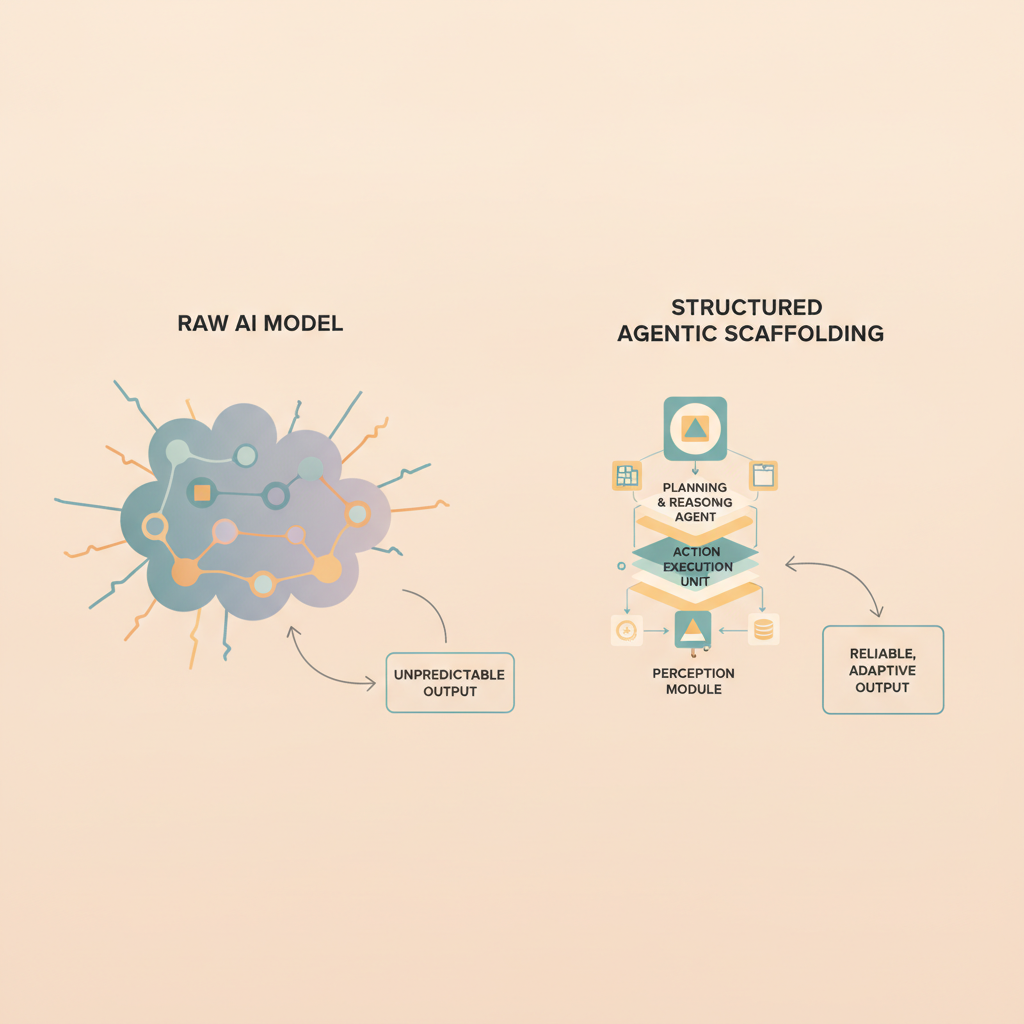
- By 2025, more than 100,000 companies had already used Microsoft Copilot Studio to build AI agents [12]. This widespread accessibility means that even small and medium-sized enterprises can now easily deploy low-code agentic tools. If you are planning to build your own custom application, you can get a quote to see how our AI-accelerated development process can save you time and money. ## Why Scaffolding Matters as Much as the AI Model When evaluating AI agent infrastructure for app creation, many decision-makers focus entirely on the underlying large language model. However, SWE-bench research reveals that the surrounding framework is just as critical as the model's raw reasoning power. In one study, three different agent frameworks running the exact same underlying model scored 17 issues apart on a set of 731 problems [2]. This proves that scaffolding, orchestration, and task context are the true differentiators in successful app creation. Without robust scaffolding, even the most powerful frontier models fail to execute multi-step tasks.
 ## Real-World Impact: Speeding Up Development and Security How does this play out in real-world software engineering? The data shows a massive transformation in daily development lifecycles. Nearly 90% of surveyed organizations use AI to assist with coding, with 59% reporting that AI agents actively free up time across code generation, documentation, testing, and review [7]. The efficiency gains are particularly striking in two areas: - Infrastructure Projects: In a case study reported by Anthropic, an enterprise customer using Claude-powered Augment Code completed a complex infrastructure project in just two weeks; a project their CTO had initially estimated would take 4 to 8 months [8].
 - Security Patching: While broad app creation remains highly complex, AI agents excel at specific, well-defined tasks. Data from Devin reveals that AI agents can remediate security vulnerabilities in just 1.5 minutes, compared to 30 minutes for human engineers, representing a 20x improvement [11].
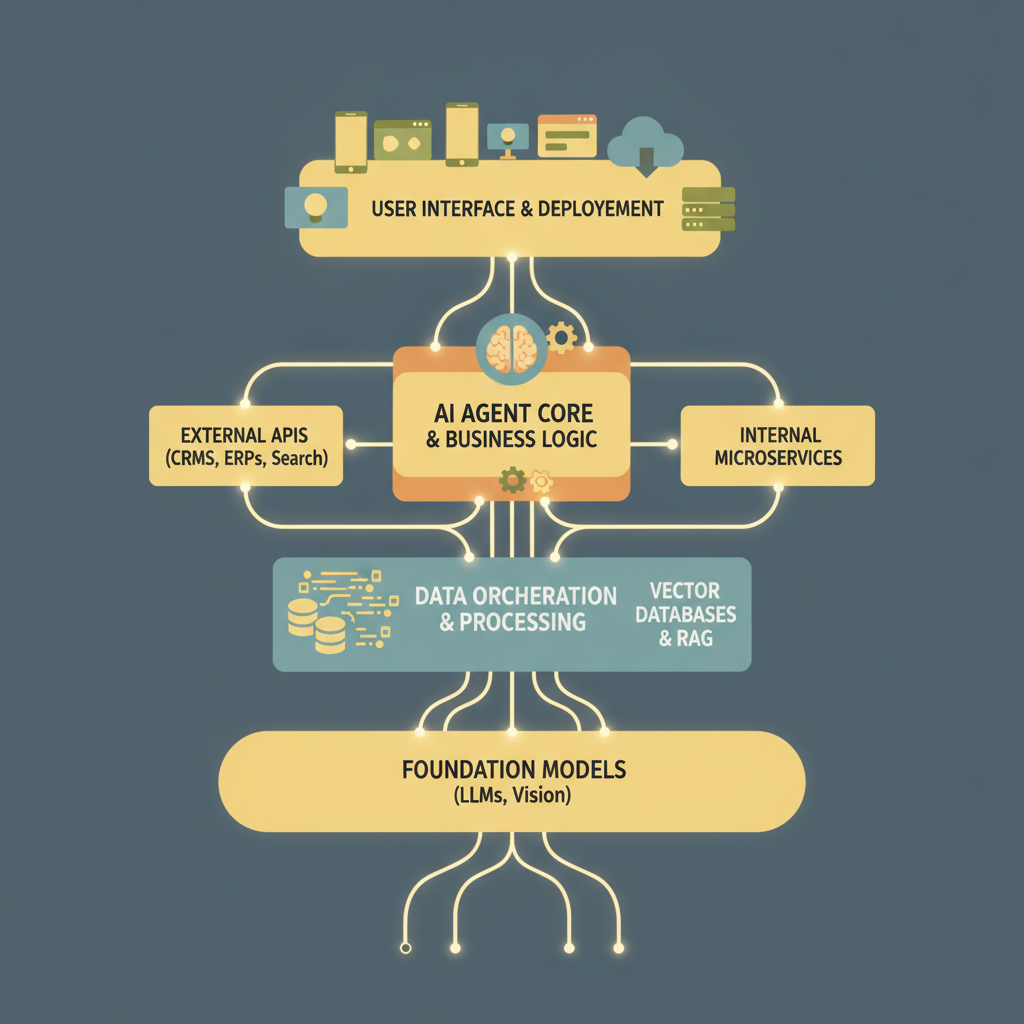
 ## The Integration Bottleneck: Why In-House Infrastructure Fails If AI agents are so powerful, why can't companies just build their own systems in-house? The bottleneck is rarely the AI model itself; instead, it is the integration layer. The 2026 Enterprise Guide to AI Agent Integration Infrastructure by Paragon highlights that building in-house integration infrastructure is exceptionally complex [13]. To create a production-ready AI agent, your system must handle: - Secure OAuth flows for various users.
 - Granular user permissions and access control.
- Automated token refreshes to prevent service interruptions. You can browse our related articles to learn more about how we handle enterprise-grade integrations.
 ## Frequently Asked Questions ### Is AI agent infrastructure ready for production app creation?
SWE-bench Verified measures an AI agent's ability to resolve real-world GitHub issues using patches that pass existing test suites, where models score over 80% [4]. SWE-bench Pro tests longer-horizon issue resolution across 1,865 problems in 41 professional repositories, where leading models currently score below 25% [4]. ### How fast is the enterprise market for agentic AI growing?
The enterprise-specific market for agentic AI reached 3.67 billion USD in 2025 and is projected to skyrocket to 24.50 billion USD by 2030 [10]. This represents a rapid compound annual growth rate of 46.2% [10]. ### Can AI agents handle security patching faster than human developers?
Yes, AI agents excel at highly specific, well-defined tasks like security patching. Data shows that AI agents can remediate security vulnerabilities in just 1.5 minutes compared to 30 minutes for human engineers, representing a 20x speed improvement [11]. ### Why is building in-house integration infrastructure for AI agents difficult?
Building in-house integration infrastructure is highly complex because it must manage OAuth, user permissions, token refreshes, and frequent API endpoint changes across third-party tools like Salesforce and Slack [13]. This integration layer is often a bigger bottleneck than the AI's reasoning capabilities. ### How much time do AI agents save software development teams?
Nearly 90% of surveyed organizations use AI to assist with coding, with 59% reporting that AI agents actively free up time across code generation, documentation, testing, and review [7]. In some cases, agentic tools have compressed 4 to 8-month infrastructure projects down to just two weeks [8]. ## Sources
- tianpan.co: https://vertexaisearch.cloud.google.com/grounding-api-redirect/AUZIYQGakO6vYvAuzwumYp_kAHUxkiWct-ZU9jQahwoBGEt9x6AbXTcweHM6gK2nSb4P_OVXKDlJbop8X_lexxnnSpOPmBeTbaKMIVJGWPHK6CpXl_Av4oTqlH_K5Uexgh_BGm9kEnJPrVbQW6uVKkQYShNTEdF2CXZVP6_9iZ73BRs=
- turinglabs.sg: https://vertexaisearch.cloud.google.com/grounding-api-redirect/AUZIYQHS_UDXlRn96vfdQve5uJKeydosKRlacDDr5XUlzYYvACpIl7uZ7xpRnMsqi5QdAGNRW7V8u1Le2vV9FMf_xukRiumv29R8ohvIpezzz0lZBZ8jljyJU3qbb0yEL931r8wg4qUavACObCEPwxz8rMYY5llIEi6XtsVjed3warwR
- openhands.dev: https://vertexaisearch.cloud.google.com/grounding-api-redirect/AUZIYQHnQGFR1N06YFpopdtg3ga0iuJSJ5XPoMy5ZnInvcR9k8nQMQkA9EOnY1ssFlhdYl8_aVBJyMT4EDc_ITkOte5ZYvu_z_eZelhO61Y5mbih2NgX6UP1G_SoDKCoc20u0-4vQABUXtnY8JTVUPAcyMAEUuA=
- madrona.com: https://vertexaisearch.cloud.google.com/grounding-api-redirect/AUZIYQGatrwKFcIwTGixJN1yf7f3DAjyw9LjU_zxeQtI8aEbSlgevAOtKwGqKDB3U6vzoRQJ3gNmQvWgPh-7CMkrUgC526-O6SGTlOHFAb0isqpYpj5LGL1HDg6iyhtehYgakE0CXD6sJOWUWkeDC_4qcCFmVxHb_659UxZ5CiPxN3u2Qc2kY2YdRsSGnZxu
- anthropic.com: https://vertexaisearch.cloud.google.com/grounding-api-redirect/AUZIYQGH_9FPvcrtWzlaMbB_6Eo_kUQNqHHuaHAG_8232QeBZw--uWviYV0iviwI8GjEPc1qsSC4WkUUiVy1XKuODInCVZ4VED9p8xDwiKe-0374IqpCLIaCcj6l9SFxDg-E_c4Rd4yHnjk5VTl9eDwXyz-cQrVlbDofkbZxMrhyZUdcKO_POG4kbyuP
- mordorintelligence.com: https://vertexaisearch.cloud.google.com/grounding-api-redirect/AUZIYQFx4Oh0P3JjmvalvTT56fQQVVdfAycu2bTZcEjaXIQCe7ycGoX6pi_7GCsA3SQQBc2n3qJj0XS3-CbsEbhQ39HqLk0YNJKTjM8THpKKnIphjZxDNwXpaOOheeIMGhtSMGUB83Tl0htkoRNJGt-pHI1YgBy6Bjm8N_SLKelmmSp0pOXiG9gbLk6Yo_NerQYcHI7qPDO_kKtLJFwwkWryS1JN2_S1tg==
- codegen.com: https://vertexaisearch.cloud.google.com/grounding-api-redirect/AUZIYQHVI5pT5i2XRWyibzq4imutYZOFyZSXxidHXRwaseRdGFZi6JhvtrWRUkg_8uAAIt2U1kFIkk5KBRfTcmxZTA-TspcyObTOfPkZoAmEmhGsjU5fyzuHw9mcVSFcPw==
- youtube.com: https://vertexaisearch.cloud.google.com/grounding-api-redirect/AUZIYQHZbquHD09dbL_lfvuie8dl5Awqa0fNMKvPL3mloQCRa8wF21KEHDWspujS6_VDSHRIfwsErbn7ADxkLvRMJWPYkxCP1hVr8aYVq6aZCWa-GUyYvvMallnhByqEFvVDmZY=
- useparagon.com: https://vertexaisearch.cloud.google.com/grounding-api-redirect/AUZIYQEBrddjKWCkQS4zV2W2rJZAljlL42AAj2oZ0H40GEeFb70TlxWg7oqy0_jkE-npHh6whYLXBIBRUMDSJJaoKZjYtAkwdBxUKLEk2PFgKiqmTue8iKBDo99a7xJR757tIvDEoI3zsDVVw1KNIYpA8GoIrzZfjemoVtU=
David Friedman — Founder & Lead Engineer, AppBrewers · LinkedIn
David Friedman founded AppBrewers to turn agentic AI into shipped software. He builds the infrastructure that automates app creation and deployment, so products go from idea to production in weeks, not months. He is also the builder of Conversify, an AI communication platform for service businesses. Based in Malta, serving clients across Europe, the US, and the UK.